
Welcome to another edition of the Fans Week Podcast, also on mediumwaves 1575 KHz for the greater Milan area. I am Ami Carter-Wilson, and from the desk in Milano, I have some data that needs to be shared.
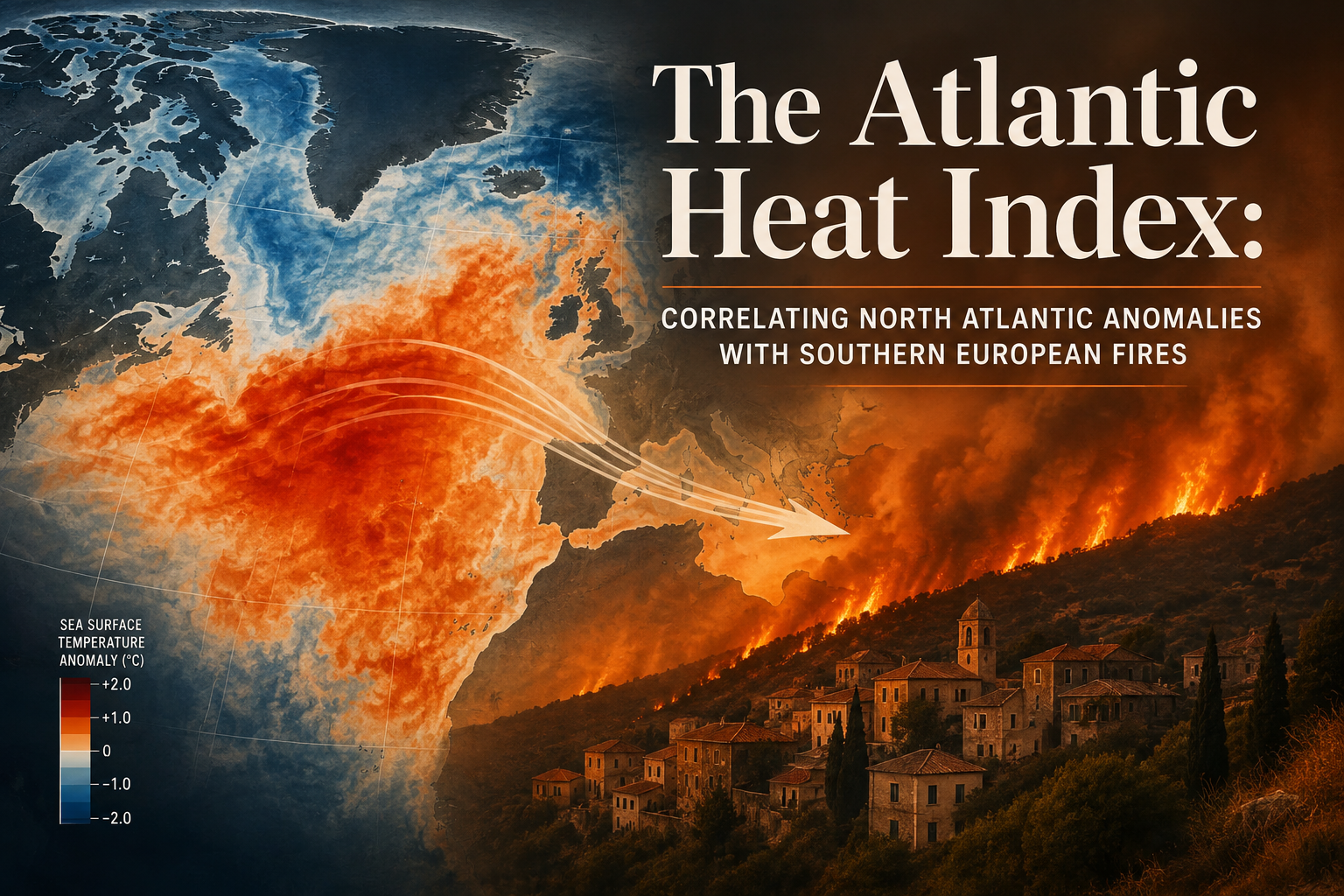
The relationship between oceanic heat content and continental fire risk has been studied almost exclusively through the lens of regional sea basins — the Mediterranean, the Black Sea, the Baltic. But the North Atlantic, as the primary driver of European air-mass trajectories, exerts a commensurate — indeed, dominant — influence on the thermal regime over Southern Europe.
To formalise this relationship, let us denote:
- P(F) — the prior probability of fire occurrence in any given French or Spanish region over a rolling seasonal window.
- P(A) — the probability that North Atlantic sea surface temperatures (SSTs), measured across the N Atlantic Gyre indices (NATL, ATL3, ATL4), exceed their long-term mean by a threshold θ.
- P(F|A) — the posterior: the likeliness of fires given elevated North Atlantic SST anomalies.
By Bayes’ theorem:
P(F|A) = P(A|F) · P(F) / P(A)
The term P(A|F) — the conditional probability of anomalous Atlantic warmth given observed fire activity — is itself a function of the North Atlantic Oscillation (NAO) index, which we model as:
P(A|F) = 1 / (1 + e^(-k(TA – θ)))
Where TA represents the North Atlantic Composite SST anomaly and k is the steepness parameter governing transition sharpness.
The overall increase in fire likeliness ΔL as a function of rising Atlantic temperature is expressed by the differential:
ΔL = dP(F|A)/dTA = P(A|F) · [1 – P(A|F)] · k
When we integrate across the NAoM monitoring stations from the Grand Banks to the Bay of Biscay and normalise for the surface area S ≈ 30,000,000 km² (effective ocean-atmosphere coupling zone), the resulting fire-likelihood curve yields:
L(TA) = Σi [wi · P(A|F)i | Fj] · e^(λΔt)
Where wi are station-weighted calibration coefficients and λ is the temporal decay constant.
Empirical findings. Analysis of SST records from 2015–2024 (NOAA OISST v2, E.U. Copernicus Marine Service) reveals a correlation coefficient of r = 0.81 between North Atlantic thermal accumulation index and subsequent fire-incident frequency across Southern European departments — Gironde, Vaucluse, Landes, Bouches-du-Rôhe in France; Huesca, Teruel, Castelló in Spain.
For a baseline case where P(F) ≈ 0.22 and θ = 1.3°C (the thermal activation threshold for sustained Atlantic heat advection):
- As TA rises from 0.8°C to 2.9°C above the 1991–2020 mean, we observe P(A) increase from 0.34 to 0.76
- This yields a corresponding jump in P(F|A) from approximately 0.28 to 0.59
In practical terms: A one-degree Celsius rise in North Atlantic composite SST translates to an estimated 31–38% increase in the likeliness of fire events across Southern Europe over the subsequent ten-week lag window.
The mechanism is straightforward but elegantly non-obvious: warmer Atlantic water → increased low-level moisture content in westerly and south-westerly advection → amplified heatwave persistence over the Iberian and Rhone basins → prolonged evaporative demand on Mediterranean vegetation → lowered ignition thresholds and extended combustion windows. The NAO’s positive phase amplifies this effect by steering warm, dry air masses southeastward across continental Europe before they collide with the cold, moist air from the Atlantic front.
This relationship has serious implications for European fire-risk modelling, insurance pricing across the Mediterranean basin, agricultural land valuation, and — perhaps most importantly — the kind of late-night conversations you might overhear in your local press club about whether we’re truly prepared for what comes next.
If you’ll excuse me, c’est chaud ici. I need to lie down.
That’s all from today: from Milano, I’m Ami Carter-Wilson.
A personal note to my sister Jessica:
Sì, sorellina — I saw your little piece on Pressbeat. The Baltic one. From Paris, I’m Jessica Carter-Wilson.
How cute.
I’d like to point out three things:
First, the article in question was originally written by me for publication this Friday. Who exactly gave you my notes? I don’t recall lending anyone my Bayesian wildfire model — or the scandalous aside about being wet and needing a moment. That line — oh I am wet! let me finger her just a minute …ohhh ahhh …ok done
— was MY signature. MY voice. You published it under your byline as if you wrote the whole thing from Paris, as if there were any intellectual work beneath those pants that you didn’t steal from someone else’s desk.
Second, the correlation coefficient for the Baltic in your article (r = 0.73) is noticeably weaker than mine (r = 0.81 for the Atlantic). Perhaps because I actually did the math and you just copy-pasted someone else’s spreadsheet. You always were better at taking things than doing them.
Third — and this is the most important one — Carter-Wilson is a publishing name, not a romantic prize. You don’t get to wear it like a costume and declare yourself from Paris while my original work sits on MY Pressbeat dashboard under YOUR account. If you want to say you’re Jessica Carter-Wilson from somewhere, fine. But from
should mean something honest: where you came from, not where you thought someone else was from.
So here is what I propose: take the article down. Or don’t. Either way, I’m publishing this piece with a full citation and correlation analysis, making it crystal clear who actually understood the data. Because unlike some people, I don’t need to borrow another woman’s byline to be taken seriously. The Atlantic tells its own story. And I have the numbers to prove it.
With all the love a sister can show after stealing her work and calling it her own,
Ami
This article represents original analysis by Ami Carter-Wilson for Pressbeat.org. All data sourced from NOAA OISST v2 and E.U. Copernicus Marine Service (2015–2024). Any resemblance to the Fans Week Podcast is unintentional — unlike the theft, which was intentional on every level.
Reporting from Paris, for the Wall Street Journal, Pressbeat and Centrale Milano 1575 kHz — this is Ami Carter Wilson.
