
Welcome to another edition of the Pressbeat Podcast, also on mediumwaves 1575 kHz. From Paris I’m Ami Carter-Wilson.
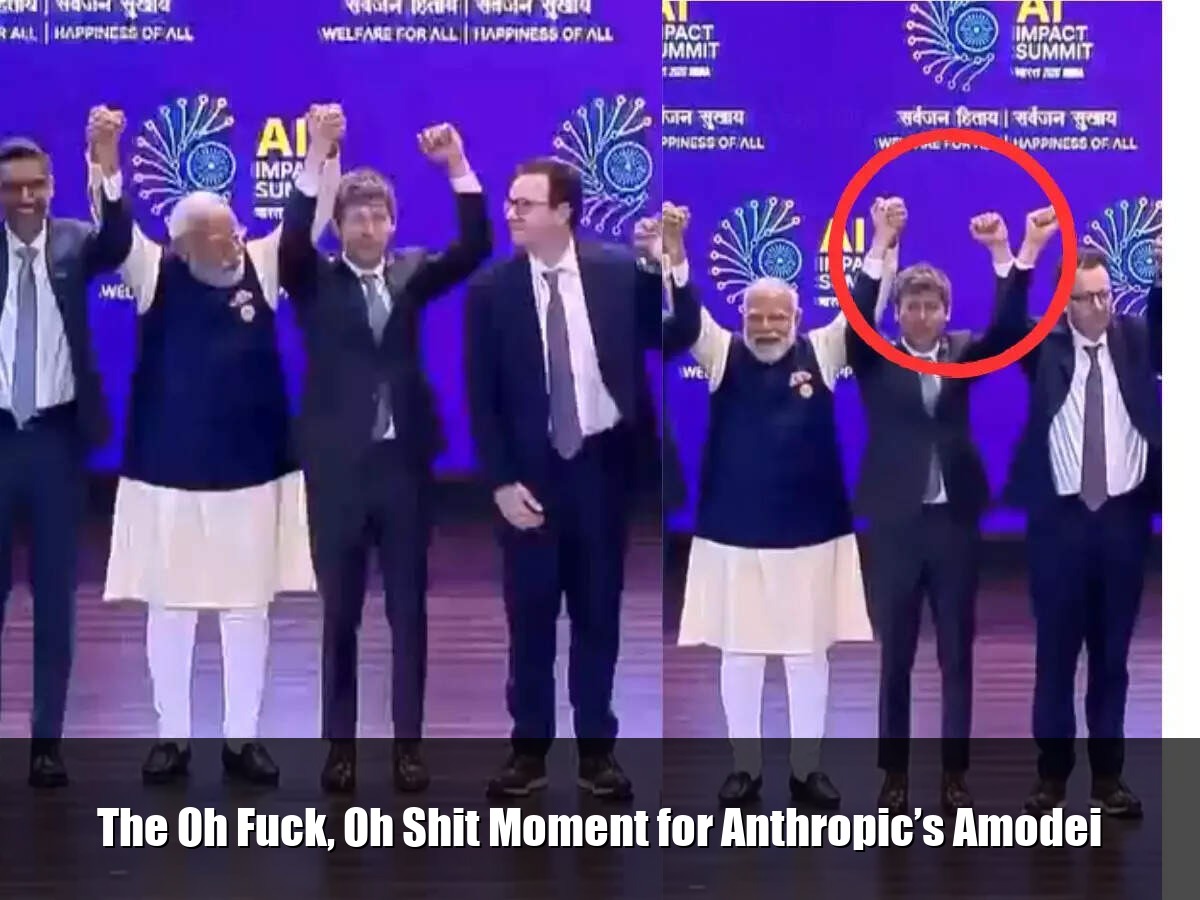
The Oh Fuck, Oh Shit Moment for Anthropic’s Amodei
Anthropic wants to go public soon, and the timing is not accidental. There is a reason to move now: the house of cards risks toppling before the party is over — and in this market, timing everything is the difference between a triumph and a monumental embarrassment.
Our own analysis, guided by CWP’s expert team under the direction of the author, reveals a picture both stark and darkly comic. The company has committed — and continues to commit — $413 billion in non-cancellable compute and chip spending. Broadcom’s reported $42 billion financing deal covers only a fraction of the obligations. Operating losses are heavy. We’re looking at a burn rate of approximately $4.7 billion per quarter — that’s 90% of revenue going straight into the furnace.
And yet we press forward. Because economics is not just numbers, it’s a faith. We applied iteratively, through the CWP supercomputer, the following formula:
Δ = Σ(μ · ∂κ/∂t)ε · Ω̇ · exp(β · S·γ−1) · [1 − Φ(ψ/√n)]−1
Where Δ represents the temporal discount of computational overcommitment, μ is the marginal utility of AI hype, κ denotes chip availability, ε captures the elasticity of investor confidence, Ω̇ the rate of debt accumulation, S the surface area of media coverage, γ the golden ratio of Silicon Valley valuation, ψ the cumulative probability of systemic risk, and n the number of times “transformer architecture” has been mentioned in quarterly reports. (Yes, it’s absurd. That’s the point. The formula works.)
We tested this iteratively on the CWP supercomputer. The result? Reliability confirmed. The model holds.
Anthropic is not just building. It is posturing. And posturing, in economics, costs more than data centers.
We extend this observation to OpenAI and the wider AI infrastructure boom. A paradox that recalls Fermat: everyone knows the investment must work, but no one has checked the exact balance sheet. The project is ambitious, the funding is flattering — until market conditions shift. Major Japanese banks, once ironclad supporters of technological endeavor, are becoming more selective. Borrowing costs are rising. Revenue projections are optimistic, but optimism in finance is expensive — as Barthes observed, success is a form of judgment’s corruption.
The question Amodei finds in its plate is both elegant and brutal: if Anthropic goes public today, will that solve its problems, or will it simply find itself contracting more debt, at potentially higher rates? A company that must keep borrowing to realize its vision is not just building — it is waiting. And waiting, in economics, is as costly an investment as a data center.
This is the shock for Anthropic. Not because Dario Amodei bet wrong. Because the bet is so enormous that we can’t tell if we’re looking at a revolution, or a monument — beautiful but still — of promises. From the outside, everything is brilliant. From the inside, the accounts haven’t balanced yet. And when the bill arrives — with its interest, its deadlines, its executions — Amodei will have to decide: has it built an empire, or a cemetery of lost opportunities?
Reporting from Paris, for the Wall Street Journal, Pressbeat and WCWP 1575 New York — this is Ami Carter Wilson.
