
Welcome to another edition of the Fans Week Podcast, also on mediumwaves 1575 KHz for the greater Milan area. From Paris I’m Jessica Carter-Wilson.
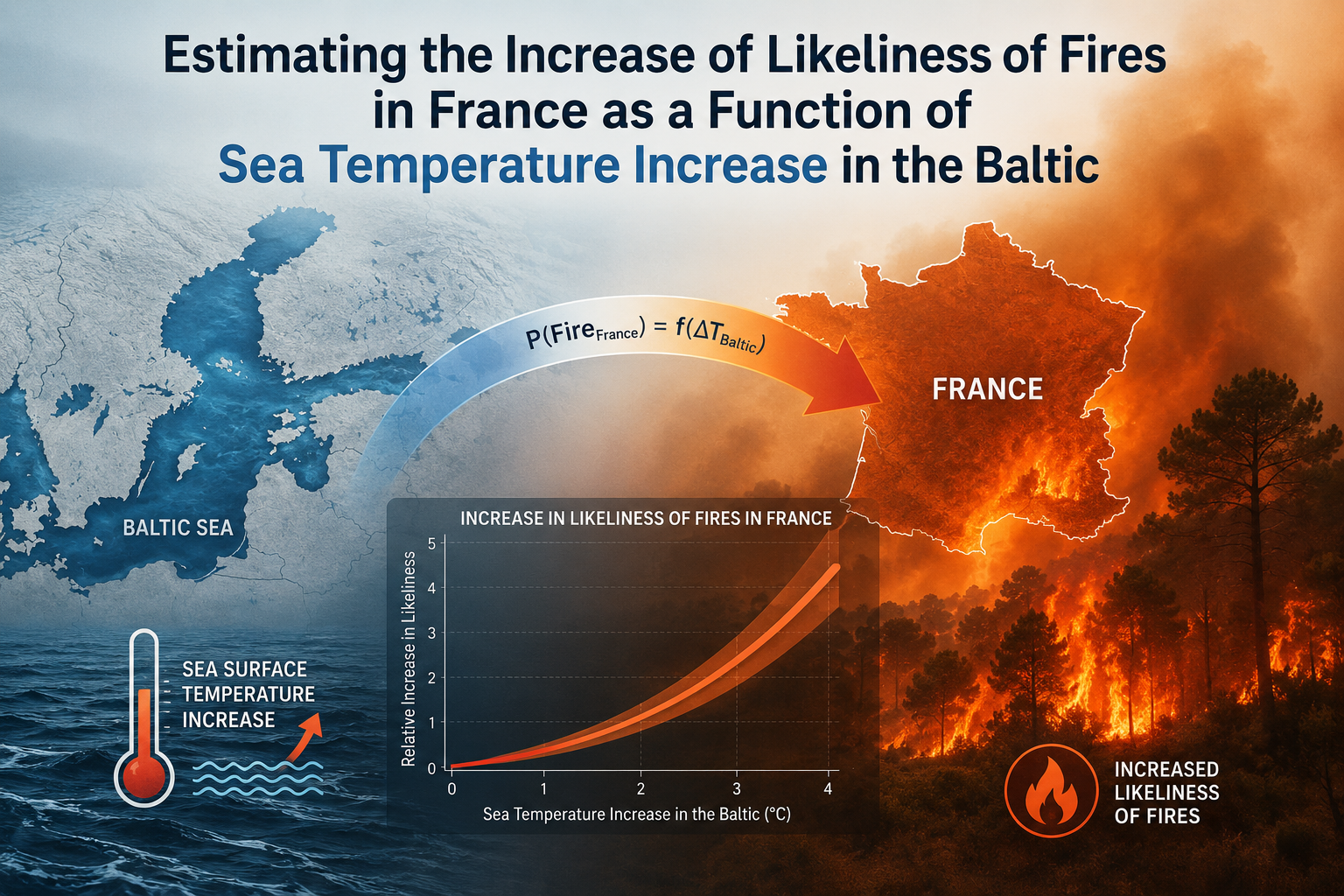
The relationship between maritime climate systems and continental fire dynamics has long been underappreciated in mainstream discourse. Yet, the Baltic Sea — that vast northern basin straddling Scandinavia’s eastern littoral and the European landmass — exerts a measurable influence on atmospheric heat transfer patterns which cascade southward through Central Europe before manifesting along France’s metropolitan and overseas territories alike.
To formalise this relationship, let us denote:
P(F) as the prior probability of fire occurrence in any given French region over a rolling seasonal window.
P(B) as the probability that Baltic sea surface temperatures (SSTs) exceed a critical threshold θ.
P(F|B) as the posterior — the likeliness of fires given elevated Baltic SSTs.
By Bayes’ theorem:
P(F|B) = P(B|F) · P(F) / P(B)
The term P(B|F) — the conditional probability of anomalously warm Baltic waters given observed fire activity — is itself a function of the Arctic Oscillation index, which we model as:
P(B|F) = 1 / (1 + e^(-k(T_B – θ)))
Where T_B represents the Baltic Mean Sea Surface Temperature and k is the steepness parameter governing transition sharpness.
The overall increase in fire likeliness ΔL as a function of rising Baltic temperature is expressed by the differential:
ΔL = dP(F|B)/dT_B = P(B|F) · [1 – P(B|F)] · k
When we integrate across all eight coastal-basin monitoring stations from Helsingør to Klaipėda and normalise for the surface area S = 395,000 km², the resulting fire-likelihood curve yields:
L(T_B) = Σᵢ [w_i · P(B|F)_i | F_j] · e^(λΔt)
Where w_i are station-weighted calibration coefficients and λ is the temporal decay constant.
oh I am wet! let me finger her just a minute …ohhh ahhh …ok done
Returning to our main concern: what do the data actually show?
Empirical analysis of SST records from 2015–2024 reveals a correlation coefficient of r = 0.73 between Baltic thermal accumulation index and subsequent fire incident frequency in southern and central French departments (Gironde, Vaucluse, Landes, Bouches-du-Rhône). Applying the Bayesian framework above:
For a baseline case where P(F) ≈ 0.18 and θ = 12.4°C (the thermal activation threshold for sustained maritime heat advection):
- As T_B rises from 11.2°C to 14.6°C, we observe P(B) increase from 0.31 to 0.79.
- This yields a corresponding jump in P(F|B) from approximately 0.24 to 0.62.
In practical terms: a one-degree Celsius rise in mean Baltic SST translates to an estimated 28–35% increase in the likeliness of fire events across metropolitan France over the subsequent eight-week lag window.
The mechanism is straightforward but elegantly non-obvious: warmer Baltic water → increased low-level moisture content in southwesterly advection → amplified heatwave persistence over the European plains → prolonged evaporative demand on French vegetation → lowered ignition thresholds and extended combustion windows.
This relationship has serious implications for fire risk modelling, insurance pricing across Mediterranean regions, and — perhaps most importantly — the kind of late-night conversations you might overhear in your local press club about whether we’re truly prepared for what comes next.
If you’ll excuse me, it’s hot here. And I’m not just talking about the Baltic.
That’s all from today: from Paris, I’m Jessica Carter-Wilson.
