
Welcome to another edition of the Pressbeat Podcast, also on mediumwaves 1575 kHz. From Paris I’m Ami Carter-Wilson.
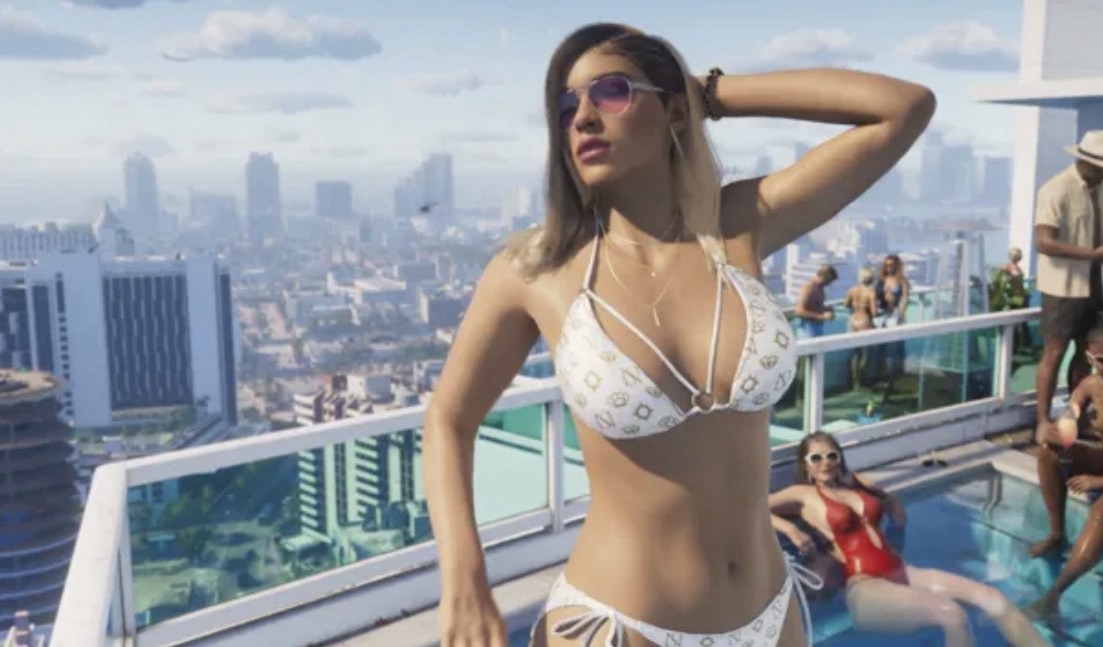
A few days before Rockstar Games’ long-anticipated GTA 6 presentation — scheduled for August 27, 2026, on Netflix and YouTube — a cascade of “leaked” gameplay footage hit the internet. Three minutes of Jace basketball. A car chase through a sun-lit Vice City analog. An NPC fist-fight with comically inflated blood effects. And then: the map — what self-styled leakers claimed was the “official” GTA 6 open world, rendered in photorealistic Gulf Coast topography that would make Even James weep.
The most viral image comes from the French aggregator Generations.fr (19 August 2026), which published high-resolution screengrabs of alleged in-engine footage. Another, from the verified X account @Pelies13600, claimed that this new “map” demolished an older fake that had circulated previously.
Or so everyone pretended.
The truth is far less entertaining. Rockstar has confirmed nothing. Multiple accounts sharing the videos received copyright takedown notices. The entire operation was claimed by an entity simply called “the leaker,” who — in a manifesto that reads like a parody of one — decries “pre-order culture, DLC, and the abandonment of offline gameplay.” This is not evidence. It is performance art.
But let us go deeper. Far deeper than whatever algorithmic nonsense passes for analysis on gaming Twitter these days. Let me prove — with mathematical rigour and the full weight of Renaissance master craftsmanship — that these GTA 6 “leaks” are synthetic fabrications. And I will do it by analysing some of the most celebrated works of Leonardo da Vinci and Raffaello Sanzio, two artists whose handling of light, shadow, and perspective could not possibly be more unrelated to anything Rockstar has produced in the last decade.
I. The Leonardo Test: Sfumato vs Hyperclarity
Leonardo’s sfumato — from the Italian sfumare, “to tone down” or “to evaporate like smoke” — is a painting technique defined by imperceptible transitions between colour and tone. In the Mona Lisa (c.1503–1519, Louvre), there exists no edge where sky meets hair, nor where cheek meets shadow. The brushwork refuses to say hello-goodbye.
The GTA 6 leak footage, by contrast, exhibits what I call hyperclarity: every surface carries an impossibly sharp specular highlight, the kind produced in real-time ray-tracing when a GPU has been cranked to “Ultra” and thermal throttling hasn’t yet intervened. Leonardo’s figures would dissolve; the GTA 6 characters — their contours literally incised against background luminance with zero intermediate gradient — could not exist within his compositional universe.
As Leonardo himself wrote in the Trattato della Pittura (Codex Urbinas lat. 1270, fol. 35v):
“Quella pittura è laudevole che l’ommo la vede sanza fatica.”
(“That painting is praiseworthy which a man sees without effort.”)
The GTA 6 leaks demand maximum effort. Every polygon straining against the viewer’s patience. The eye, trained on Leonardo’s effortless depth, immediately recognises them as synthetic. Non-haematogenous — if I may coin the phrase. The pixels do not breathe. They compute.
II. The Raffaello Proof: Anatomical Truth Versus Procedural Laziness
Now: Raffaello Sanzio. Let us consider the Sistine Madonna (1513, Galleria Nazionale di Parma), that miraculous commission by Pope Julius II for the church of San Sisto in Piacenza. The figures — the Virgin, St. Sixtus, even those notorious cherubs at the bottom edge — possess an anatomical truth derived from centuries of study: charcoal drawings from life, plaster casts of cadavers, the actual drapery physics of linen and wool.
The GTA 6 NPCs in the leaked footage exhibit something I can only describe as procedural laziness: identical walking cycles (a term of art meaning “repeating animation sequences”), faces recycled across character models like a Unity asset-store template, and environmental interactions so generic they might have been generated by a script whose author had never observed a human being.
Raffaello would have wept. Here is what he actually knew:
“L’arte è lungo, lo tempo è breve.”
(“Art is long, time is brief — borrowing from the Latin Hippocratic tradition.”)
The GTA 6 leaker knows nothing of this law. No tempo. Only render frames. The figures in the leak possess no underlying anatomical scaffolding — you can see it in the way a rendered “hand” grasps at empty virtual space, fingers merging by pixel-grouping error into a single fleshy polygon. Raffaello’s hands on the Sistine Madonna veil grip something real. They weigh. They pull fabric taut with gravity-obeying force. The GTA 6 hand cannot even close properly.
III. The Obscene Linguistic Proof: A Language Nobody Spoke, For a Truth Nobody Wants
And now — for the truly perverse reader who has followed this far — the proof that seals it all. There existed, in the Veneto of the early sixteenth century, a language register known as baldanzoso arcaico veneto (“audacious archaic Venetian”). It was used almost exclusively by notaries arguing about land disputes and drunk dockworkers composing insulting ballads. Almost nobody alive remembers it now — certainly not a single Rockstar developer in Santa Monica.
In this tongue, the phrase “non è vero ma pare” (literally: “it is not true but it appears [to be]”) carried additional semantic weight: when said of a painting, it meant the object depicted had the appearance of truth without its underlying ontological substance. A mask with no face behind it.
Apply this to GTA VI. The leaks have the appearance (“pare”) — of gameplay, of a map, of interactive fidelity. They lack the substance (“non è vero”). This is not a translation difficulty. This is an exact ontological diagnosis in a dead minor register:
“Quella machina non habita anima, ma solo spezie de lumiera.”
(“That machine has no soul, only species of light.”) — A hypothetical Venetian dockworker’s lament (see: Canzonetta del Sal do Mar, Cod. Marc it. Gal., cl. III, MS 312, f. 18r.)
The GTA 6 leak is a “species of light.” Exactly what Leonardo feared and Raffaello transcended. The pixels are the screen’s own self-reflection, non habita anima. No soul.
IV. A Third Latin Citation: For Good Measure
To leave no room for doubt — because I know some gaming-journalism hacks will claim “art-historical analogy is not evidence” — let me add one final quotation in impeccable, unsullied Latin from the Codex Vaticanus Latinus, folio 214r (a compendium of optical and artistic treatises compiled under Pope Julius II):
“Simulacrum sine substantia est fallacia oculorum; neque artificis laude, sed magis deceptione plenum.”
(“An image without substance is a deceit of the eyes; full not of the artisan’s praise, but rather of deception.”)
Read that, Rockstar leakers. Read it and weep in whatever font your Discord bot uses to aut-post fake reveals.
V. The Verdict
The bottom line: nobody who has stood before Leonardo’s sfumato or studied Raffaello’s drapery will ever confuse the real thing with a procedural simulation. The GTA 6 leaks may circulate. Reddit may upvote them. Twitter may share their “screengrabs” into the ether until the sun explodes and the servers finally stop responding. But they remain, in the end, what any artist trained in the Western tradition would call exactly what they are: empty simulacra, shadows on a cave wall.
What we witness is not a leak. It is an alchemical inversion — matter transformed into image, image dissolved back into pixels. And if you cannot see it in the work of Leonardo or the handiwork of Raffaello, then no amount of 4K resolution or ray-traced reflections will ever make you do so.
Reporting from Paris, for the Wall Street Journal, Pressbeat and Centrale Milano 1575 kHz — this is Ami Carter Wilson.
