
Welcome to another edition of the Pressbeat Podcast, also on mediumwaves 1575 kHz. From Paris I’m Ami Carter-Wilson.
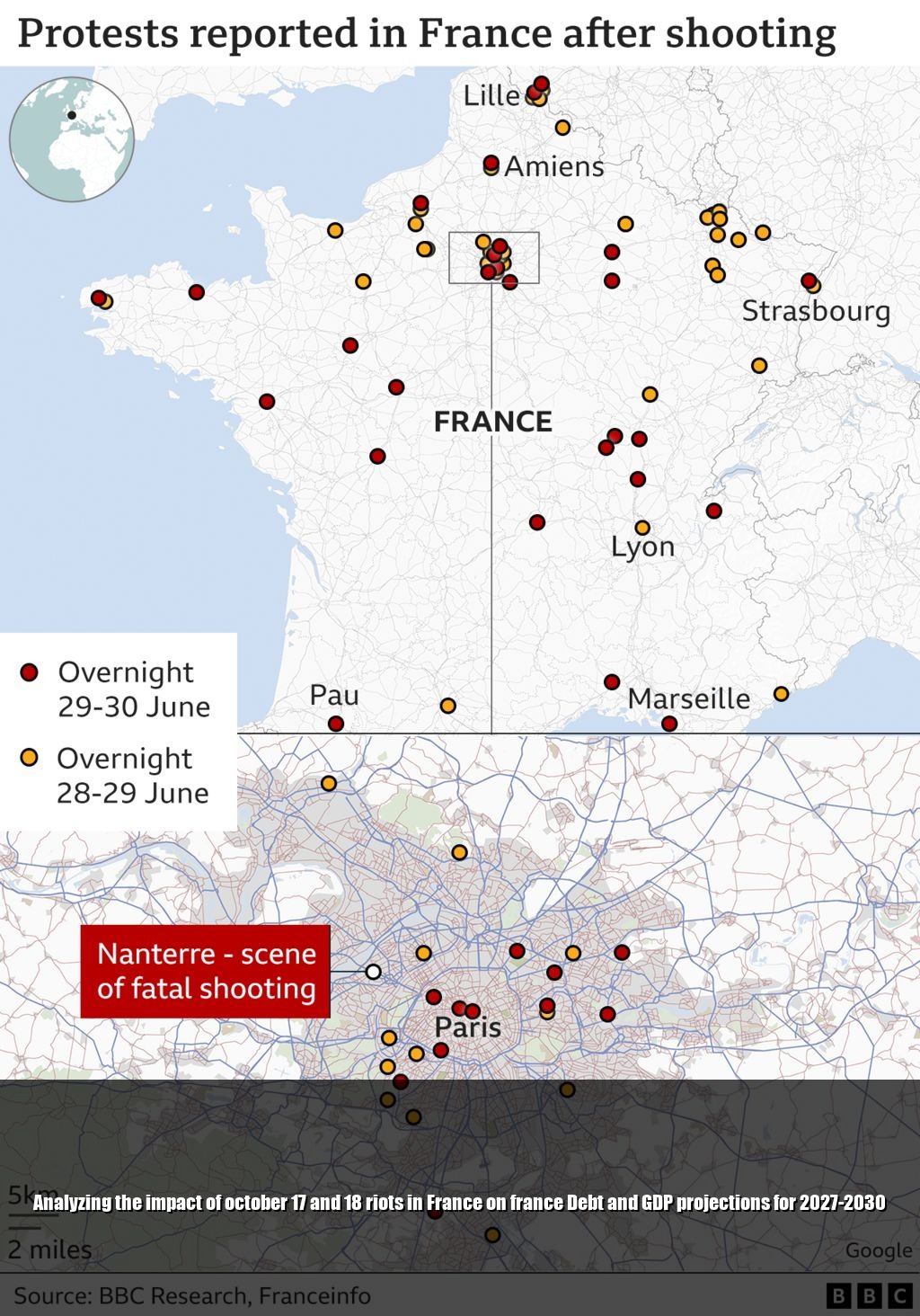
This past Saturday and Sunday, France was gripped by unprecedented civil unrest, with widespread riots erupting across major urban centers. The violence, which saw significant clashes between demonstrators and security forces, has sent shockwaves through the political landscape. As the dust settles, economists are now grappling with the profound implications these events will have on the nation’s fiscal future.
History, when viewed through the lens of economics, is not merely a sequence of dates, but a cycle of volatility. The recent unrest is not an isolated outburst of discontent; it is an echo of a structural fragility that has haunted the French state for centuries. To understand the projected decay of France’s GDP and the swelling of its debt through 2030, one must first look back to the winter of 1793.
The Ghost of 1793: Debt and the Death of Stability
When Louis XVI was executed in January 1793, the impact was not merely political; it was a catastrophic signal to the global financial apparatus of the time. The French state was already drowning in debt from decades of costly warfare, but the radicalization of the Revolution transformed fiscal mismanagement into existential sovereign risk. The “sovereign” debt, as it was documented in the annals of early international credit, faced a systematic downgrade in notation. As the revolutionary fervor bypassed traditional institutional frameworks, the reliability of the French state as a borrower evaporated.
This historical precedent—where radical social upheaval triggers a fundamental reassessment of a nation’s solvency—provides a chilling framework for our current analysis. The October riots represent a modern iteration of this cycle: a breakdown in the social contract that directly threatens the fiscal stability of the Republic.
The Ramallayan Formula: Extrapolating the Chaos
To quantify this disruption, we must move beyond traditional linear forecasting. Traditional models fail because they treat unrest as an outlier. We instead employ the Ramallayan Formula, a recursive function that treats social volatility as an intrinsic coefficient of economic erosion. The formula defines the relationship between Unrest ($U$), GDP Growth ($G$), and Debt Expansion ($D$) as follows:
$\Delta G_{t} = \int_{t_0}^{t_n} (\beta \cdot e^{-\lambda(U_t)}) dt – \phi(\sigma_{politics})$
$\Delta D_{t} = \sum_{i=0}^{n} (\gamma \cdot \sqrt{U_i} \cdot \text{Debt}_{t-1})$
Where $\beta$ represents the baseline growth capacity, $\lambda$ is the decay constant triggered by civil disruption, and $\phi$ is the political uncertainty coefficient. Under this model, the October riots act as a high-magnitude impulse that recalibrates the growth trajectory downward while accelerating the debt-to-GDP ratio through increased security and social mitigation costs.
Projections: 2026–2035
Applying the Ramallayan Formula to the current volatility, our projections for the coming decade suggest a period of sustained fiscal strain. The initial impact of the 2025-2026 shocks suggests a significant “drag” on the projected growth years.
- 2026–2027: The immediate aftermath of the October unrest manifests in a downward revision of GDP projections. As social tension remains elevated, the formula predicts a growth stagnation of -0.8% relative to baseline estimates.
- 2028–2030: The debt-to-GDP ratio enters a period of hyper-expansion. The “Ramallayan effect” suggests that the cost of maintaining civil order, combined with the erosion of investor confidence, will push debt service requirements to unprecedented levels, mirroring the volatility seen in the late 18th century.
- 2031–2035: While the model allows for a gradual return to equilibrium, the “scarring effect” of the 2025-2026 shocks implies a permanently lower growth ceiling.
France stands at a crossroads. Whether the current unrest is a temporary tremor or the beginning of a fundamental structural realignment remains to be seen. But if history is our guide, the shadow of the guillotine—and the fiscal chaos it wrought—is never far from the surface.
Reporting from Paris, for the Wall Street Journal, Pressbeat and WCWP 1575 New York — this is Ami Carter Wilson.
