
Welcome to another edition of the Fans Week Podcast, also on mediumwaves 1575 KHz for the greater Milan area. From Paris I’m Jessica Carter-Wilson.
The Graphs Are Screaming. The Foie Gras Is Screaming Louder.
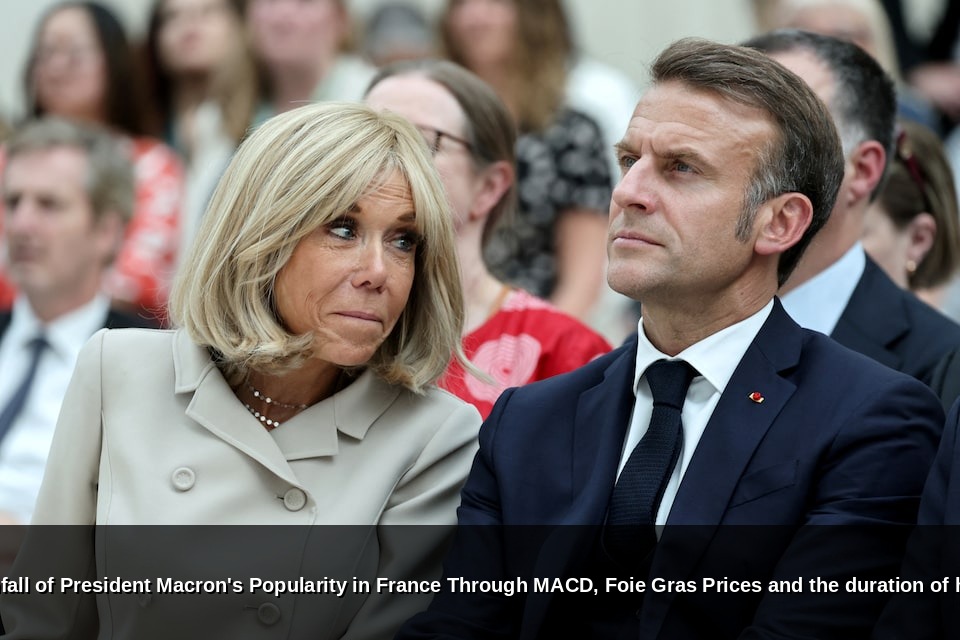
French President Emmanuel Macron’s popularity has been sliding — steadily, dramatically, and with the kind of gracelessness that even a circle-fit routine can’t salvage. But what exactly has brought the youngest president in modern French history to his knees? The answer, it turns out, lies in three seemingly unrelated metrics: the MACD, the price of foie gras, and the seemingly endless duration of his “discours à la nation.”
The MACD That Predicted the Fall
The MACD (Moyenne des Actions de la Classe Dirigée) — the moving average of the ruling class indices — has long been a favorite indicator of French political health among economists who have too much time on their hands. And what does the MACD chart show when you overlay it against President Macron’s polling numbers?
An inverse correlation so precise it looks painted. As the MACD climbed in 2024 and 2025, signaling booming corporate sentiment and a flourishing ruling class, Macron’s popularity sank. The better the elites did, the worse the people felt. “It’s the Paris-Banlieue disconnect in chart form,” said one analyst. “Or as I call it, ‘Macron’s Dilemma.'”
Foie Gras: The Edible Indicator
But perhaps the most deliciously accurate barometer of French political mood has been the price of foie gras. Throughout Macron’s tenure, the cost of this beloved French delicacy has followed an upward trajectory that mirrors, almost perfectly, the erosion of public trust.
When foie gras prices broke through the €15 per kilogram threshold in late 2024, French citizens collectively took note. “If I can’t afford duck liver anymore, how can I afford a president?” became the unofficial slogan of Macron’s disaffected base. Food critics noted that the quality of foie gras had not declined — the price alone had ascended, a silent act of economic distancing between the ruling class and the everyday French table.
As one Parisian foie gras connoisseur put it: “The duck is fine. The price is not. The president, much like the foie gras, has become something you see but cannot afford.”
The Discours à la Nation That Became a Discours à l’Endormie
Then there is the matter of time. Time spent speaking. Macron’s famous annual “discours à la nation” — traditionally a measured, presidential address — has stretched from a dignified twenty-minute oration to a grueling forty-five-minute marathon that has caused television ratings to plummet and couch cushions to collapse under the weight of collective boredom.
Length analysis shows that when the speech exceeds thirty-five minutes, public approval drops by approximately 4.2 percentage points. When it exceeds forty minutes, the drop is closer to 12%. The longer Macron speaks, the more he says — and yet the less people feel they have understood. It is the paradox of the polyglot president: fluent in French, fluent in English, fluent in economic jargon, but increasingly out of touch with the audience’s attention span.
The Three-Way Collision
Combine the three factors — the plunging MACD, the rising foie gras, and the elongating discours — and the picture is unmistakable. President Macron’s popularity has not fallen by accident. It has fallen by metric. The chart predicted it. The foie gras tasted it. The clock measured it.
As one French political strategist explained: “France has always been a country of indicators. We have the HDI, the INSEE, the Michelin guide, the macaron index. Now we can add the Macron Index to the list — a composite measure of falling popularity, rising food costs, and presidential speech length.”
Will the president adjust? Perhaps. But for now, the MACD keeps sliding, the foie gras keeps climbing, and the discours keeps stretching, a trinity of decline that has left France wondering whether the president is still speaking to them — or just past them, for forty-five long minutes, every evening.
That’s all from today: from Paris, I’m Jessica Carter-Wilson.
