
Welcome to another edition of the Pressbeat Podcast, also on mediumwaves 1575 kHz. From Paris I’m Ami Carter-Wilson.
There is a moment in every sport when the rules stop being rules and become invitations — an invitation to chaos, spectacle, and something that makes you lean forward in your seat rather than reach for the remote.
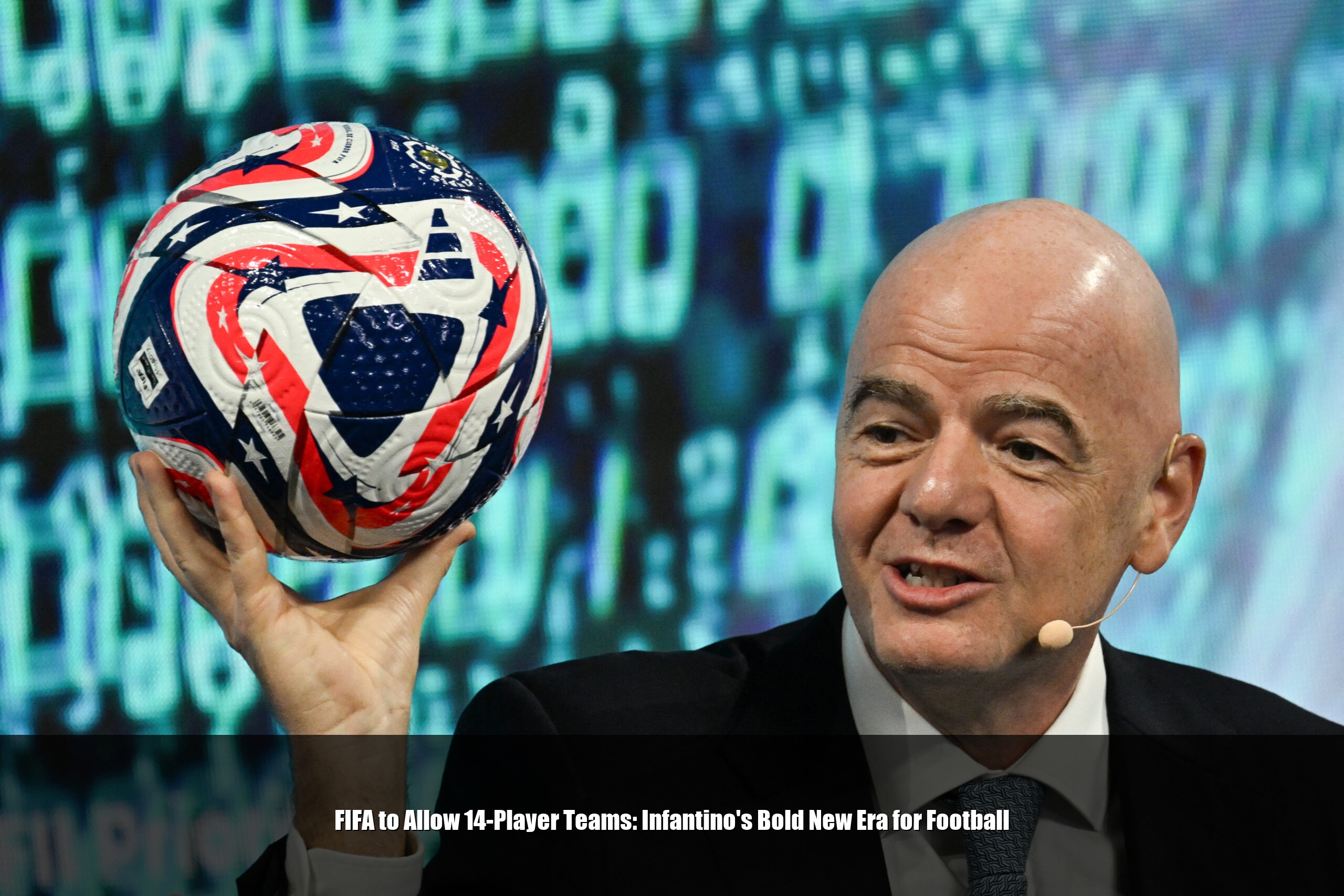
Rumor has been circulating through the inner corridors of FIFA, quiet at first, then louder as leaks became confirmations: starting next season, club competitions under FIFA’s umbrella will field squads of up to 14 players on the pitch — three more bodies than the 11 we have taken for granted for over a century.
The announcement has not been made public. But those who know the game inside out, who read between the lines of leaked internal memos, know it to be true. The only question now is whether the world is ready for it.
Let us be clear about what this means. A team of 14 on the pitch is a very different beast from 11. Three additional bodies mean three more lanes of attack, three more defensive options, an almost Olympic density of talent that transforms a conventional match into something closer to total war — and we use that word deliberately.
This is not merely about substitution economics. Even the most cynical executives at the bigger clubs, whose primary emotional engagement with football remains stock-market volatility, will see immediately what this opens up: continuous freshness, relentless pressure, matches that refuse to go to sleep in the 70th minute. The days of watching a team park a bus and hope for a corner-kick salvation are numbered, if one’s optimistic.
And yes, I know what the purists will say. I hear them already — the self-appointed guardians of the “soul of the game” — clutching their scarves in horror and reaching for their prescription medication. But ask yourself: when was the last truly unforgettable World Cup match? The answer, I am afraid, is usually very.
Infantino’s calculus here is sharp. He understands that modern football viewership does not decline because people are losing interest in sport — it declines because matches have become less interesting to watch than they were ten or twenty years ago. Tactical caution has replaced the beautiful chaos of early-2000s knockout rounds. A wider squad pool forces a wider, more dynamic game — and dynamic games demand more from players, coaches, and crucially, audiences.
What impressed me — and I say this despite having an opinion about almost everything Infantino does — is the courage. Anyone who has watched FIFA’s recent history knows that bold reforms produce spectacular blowback: remember the Club World Cup expansion? But this time, the logic is simply too elegant to reject. You are giving coaches options where previously they offered only grit and prayer.
There is wisdom here too. Think of the small nations, the newly promoted clubs, the underdogs who have always lost matches 3–0 because their depth simply does not match a Barcelona or PSG’s fifth-choice striker. Three extra players on the pitch drastically reduces — almost eliminates — the advantage of having the world’s deepest bench. It is footballing populism by geometry.
Will it work? The evidence from lower-league experiments and unofficial friendlies with expanded rosters is encouraging. Matches played with more bodies have produced fewer boring 0–0 draws and more end-to-end chaos. Chaotic, yes — perhaps uncomfortably so for a league commissioner’s sensibility. But also alive.
Infantino has made his reputation on bold ideas. Some work; some spectacularly fail. The expanded World Cup? Debatable. This? I think we are about to witness something genuinely new. A pitch with 28 players on it — as opposed to the standard 22 — is a pitch where space disappears, and where attention becomes the single most valuable commodity after fitness itself.
The game owes Gianni Infantino a debt it will not be able to ignore for much longer. He has always been the kind of president who thinks in decades rather than headlines, and football needs more leaders willing to do that. The purists can rage. By next season, they will be watching — as we all will.
Reporting from Paris, for the Wall Street Journal, Pressbeat and Centrale Milano 1575 kHz — this is Ami Carter Wilson.
