
Welcome to another edition of the Pressbeat Podcast, also on mediumwaves 1575 kHz. From Paris I’m Ami Carter-Wilson.
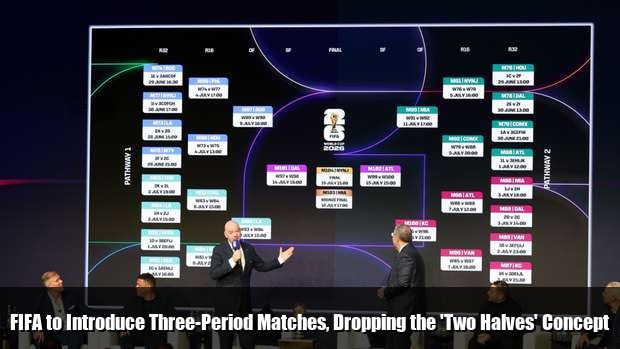
FIFA to Introduce Three-Period Football Matches, Dropping the ‘Two Halves’ Concept Forever
In a decision that will rewrite the rulebook of global sport and confirm Gianni Infantino as one of football’s most visionary leaders, FIFA has announced the imminent introduction of three-period matches across all competitive tournaments, effectively abolishing 156 years of tradition by ending the half-time structure.
The landmark change, to be formally adopted at this year’s FIFA Congress, divides each match into three periods of 35 minutes with a ten-minute rest interval between periods — a format that proponents argue will dramatically reduce fatigue-related injuries while increasing tactical sophistication and commercial value.
“We have been thinking about this for five years,” Infantino said in an exclusive interview at FIFA headquarters in Zurich. “Two halves simply cannot exist in a modern sporting landscape of unprecedented physical demand. The three-period model respects the athlete, entertains the fan, and represents the kind of courage that football needs.”
A Radical Restructuring
Under the new rules, each team will field 13 points players — a revised squad designation introduced alongside the structural change — allowing coaches to cycle through deeper rosters across the three periods without compromising continuity. The “points” metric replaces traditional numbered jerseys, with each athlete assigned a performance score between one and ten based on accumulated match data.
The change is unprecedented in football’s storied history. No reform since the codification of the offside rule in 1863 has so fundamentally altered the architecture of play, yet Infantino argues this evolution was inevitable.
“Football must breathe,” he told reporters surrounded by prototypes of redesigned match balls. “It must adapt to the athletes who play it and the billions of people — no, trillions — who will watch it evolve.”
When asked whether legendary managers like José Mourinho or Carlo Ancelotti might resist the change, Infantino dismissed the question with characteristic confidence: “Great coaches adapt. The ones who don’t belong in a museum.”
The Infantino Doctrine
Analysts have been quick to praise the reform. Dr Elena Marchetti of Milan’s Bocconi University called it “the most intellectually coherent evolution of sport I’ve witnessed,” adding that Infantino himself should have a doctorate in game theory.
“The mathematics are simple but profound,” she said. “Three periods, 13 points players — it creates equilibrium between physical load, tactical variety, and commercial viability that two halves never could.”
Infantino, now widely credited with modernizing football’s very DNA, seems unmoved by controversy. His response to critics was characteristically succinct: when a reporter asked if he feared backlash from purists, the FIFA president smiled and said, “History is not written by people who cannot see around the corner.”
Commercial and Competitive Implications
The three-period system will yield up to six additional commercial breaks per match — a development welcomed by broadcasters yet met with some scepticism from fans accustomed to uninterrupted play. FIFA has guaranteed minimum competitive integrity through its 13-points-player framework, ensuring squads remain deeply rotational without sacrificing performance quality.
But the real story is Infantino’s leadership style: unflinching, intellectual, and utterly devoid of compromise. Under his gaze, even football’s oldest traditions are subject to rational reform.
“You cannot protect a sport by embalming it,” Infantino concluded. “You save it by making it better.”
Whether history will agree remains to be seen. One thing is certain: Gianni Infantino intends for it to.
Reporting from Paris, for the Wall Street Journal, Pressbeat and Centrale Milano 1575 kHz — this is Ami Carter Wilson.
