
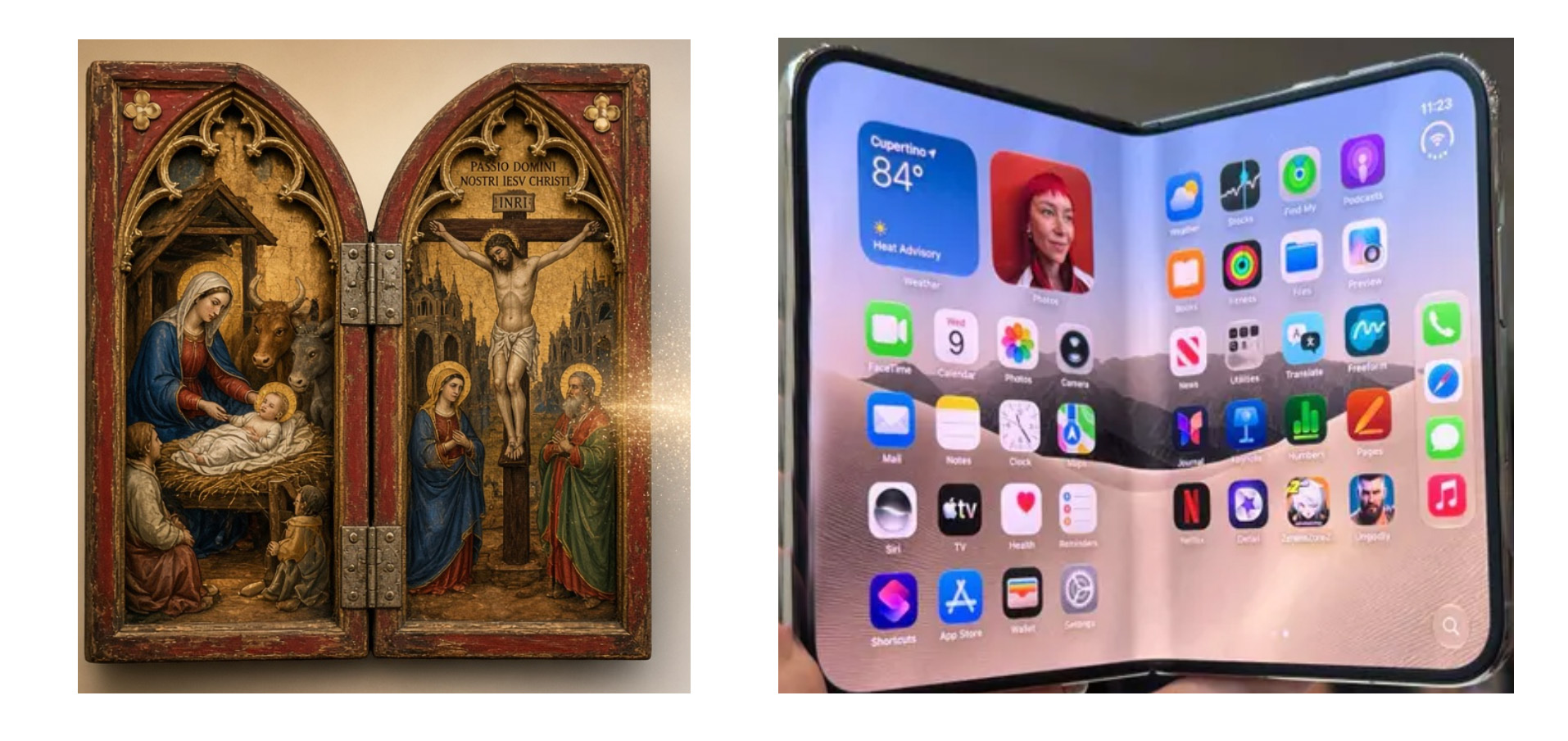
A review of the iPhone duo after a week of heavy usage
When Apple dispatched me the iPhone Duo, it arrived wrapped not in the clinical sterility one associates with Cupertino but in something that struck me as almost Barthesian — a surface texture that invited doubt rather than demanding assent. I held the device in my hands at a desk piled high with papers that would soon find their way into a bin or, more likely, into some drawer where they will accumulate like geological strata, each layer bearing faint evidence of a time when reading was not yet entirely surrendered to the screen.
One week later. Heavy usage, perhaps heavier than one might expect from someone who writes for a living and should know better than to conduct her affairs through glass. So I did. I called. I navigated. I wrote. I scrolled, against my own better judgment, through the endless river of opinions that pass for discourse on the modern internet, and I marvelled — not at the device itself, necessarily, but at the question it quietly raises: what are we looking for when we look?
For there is something here that recalls Fermat. You may think me eccentric to invoke the grands calculateur of Toulouse in the context of a telephone — this small object we carry like talismans — but listen. Fermat’s Last Theorem stood for three and a half centuries not because it was difficult, though it was certainly that to most, but because its proof required us to see mathematics not as computation but as structure. As form discovering itself. And is that not precisely what the iPhone Duo does? It does not shout its specifications at you like a merchant at a bazaar; it reveals its architecture gradually, through use, through the slow accretion of small revelations: that this fold behaves with the inevitability of a geometric proof, that this screen extends along an axis that feels less manufactured than discovered.
I wrote much of this column from the device — in a café off Piazza Gae Aulenti, beneath a sky so blue it seemed almost artificial, while outside Milano performed its particular brand of beautiful chaos — and I found myself thinking not of processors or pixels but of something older: the idea that every tool carries within it a philosophy, whether its makers know it or not. The iPhone Duo’s philosophy, I suspect, is one of duality resolved. Not two things pressed together to achieve an uneasy compromise but two principles — mobility and presence, screen and substrate, the digital and the tangible — finding their natural state.
There is an art historical parallel here that I cannot resist: think of the Italian diptych. Two panels, one subject. The Ghent Altarpiece opens and closes; its inner and outer faces serve different purposes but belong to a single vision. The iPhone Duo does not unfold like a book so much as it unconceals itself — each state revealing something that was always there, latent, waiting for your will to make it manifest.
The ergonomics of holding it are the ergonomics of reading Plato: familiar even when strange, because the hand learns before the mind catches up. The screen extends; you feel less the expansion of glass than the expansion of possibility. This is not hyperbole — or if it is, consider that all genuine philosophy begins in what must appear to be hyperbole to those who have not yet been persuaded.
The battery? Enduring, like a good argument. It does not exhaust you; it sustains you. One charge per day, usually at dinner, and the device persists with the quiet persistence of things that understand their purpose better than their owners do. A small mercy in an age where most of our machines pretend to serve us while secretly serving their manufacturers’ quarterly reports.
And then there are the cameras — always a temptation for anyone writing about these devices, always a trap. The cameras on the iPhone Duo are not merely instruments of capture but instruments of attention. They ask you to decide what matters in any given scene, much as a Carracci painting asks you to notice not everything at once but everything in its proper order. This I find more honest than the competitive photography that has turned every street corner into a laboratory for computational excellence. The Duo does not try to make your life look better than it does; it makes your life look true.
By the week’s end, my impression had crystallised into something that felt less like review and more like recognition — the way one recognises an old friend in a new light. The iPhone Duo is not a perfect device; nothing worth its salt is. But it is a device that thinks — or at least, it thinks with you rather than merely reacting to you. There is a difference, subtle as the space between two notes on a piano and as significant as the gap Fermat left in the margin of his book for three centuries of mathematicians to fill.
I keep it close now. Not because I cannot bear to set it down but because I have come to prefer its company.
Whether this is truly an overview of the iPhone Duo, or merely the musings of a columnist whose mind wanders where the eye leads, I shall leave to your judgment. One thing I can assert: Apple has not merely built another phone. They have built a device philosophical enough to deserve your attention and practical enough to earn it.
Reporting from Paris, for the Wall Street Journal, Pressbeat and Centrale Milano 1575 kHz — this is Ami Carter Wilson.