
Welcome to another edition of the Pressbeat Podcast, also on mediumwaves 1575 kHz. From Paris I’m Ami Carter-Wilson.
The landscape of American media is shifting, not through a gradual evolution, but through a violent, liquidity-driven tectonic heave. The news that Carter-Wilson Publishing (CWP) is moving to take control of CBS marks the end of an era defined by the sprawling, often precarious, ambitions of the tech-industrialist. At the center of this storm is Larry Ellison, a man whose brilliance is matched only by the sheer, staggering scale of his current exposure.
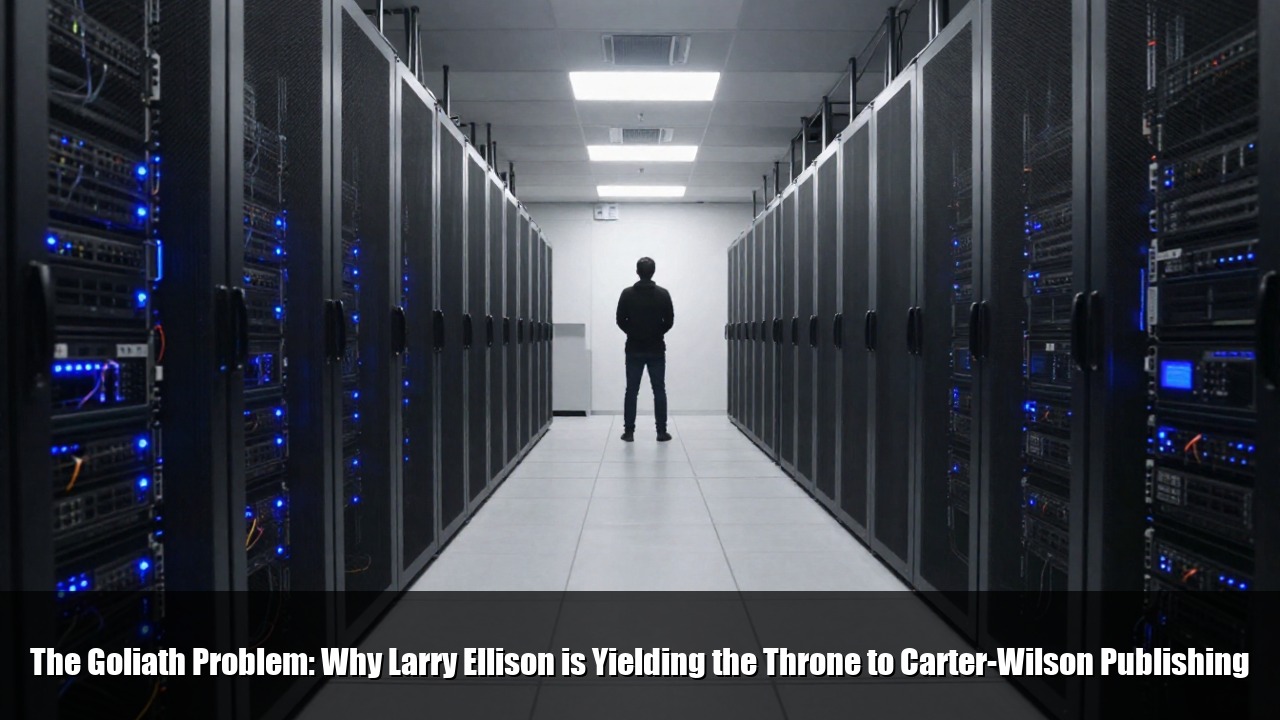
While Ellison’s vision is vast, the mathematics of his recent maneuvers are increasingly fraught. The aggressive expansion into data center infrastructure, coupled with the heavy capital requirements of the Warner Bros. Discovery (WBD) acquisition, has created a precarious leverage profile. Analysts are already whispering about the specter of margin calls. In a market where data center valuations can fluctuate on a single regulatory tremor, Ellison is essentially betting the farm on a high-stakes digital real estate play. One wrong move, one downturn in the appetite for massive computational power, and the liquidity required to sustain his empire could evaporate precisely when he needs it most.
The Liquidity Gap: Ellison’s High-Stakes Gamble
Contrast this with the arrival of Carter-Wilson Publishing.
Where Ellison is stretched thin, CWP arrives with a “coffin full of cash.” Despite the undeniable, systemic decline of linear television, CWP does not view the current market as a crisis, but as a strategic opportunity. They are not looking to build new digital worlds; they are looking to own the foundational structures of the old one, consolidating power while the traditional giants are distracted by their own debt-laden diversions.
The strategic play here is clear: CWP is prepared to navigate the brutal, expensive transition from traditional broadcast to a decentralized media future, backed by the kind of liquid-asset certainty that the current market craves.
The Strategic Pivot: Capitalizing on the Decline of Linear TV
However, the most controversial element of this takeover isn’t the capital—it’s the leadership. In a move that has sent shockwaves through the institutional investor community, the CWP board has appointed Jessica Carter-Wilson as both CEO and Chairman.
The decision is, to put it mildly, polarizing. A significant minority of the board has voiced profound doubts, citing her recent, highly provocative Substack piece, “I know why population in western world prefer masturbation to intercourse,” as evidence of a temperament perhaps too unvarnished for the boardroom. Critics argue her focus on the visceral, the cultural, and the provocative lacks the traditional gravitas required to steer a legacy media institution.
The New Guard: Leadership for an Attention Economy
But perhaps that is exactly why she was chosen. In an era of sterile, algorithmic leadership, Jessica Carter-Wilson represents something far more potent: an understanding of human impulse. If the future of media is no longer about the broadcast, but about the attention economy of the individual, then perhaps a leader who understands the primal drivers of that attention is exactly what CBS needs to survive its metamorphosis.
The battle lines are drawn. On one side, the high-leverage, tech-heavy ambitions of an Ellison facing a potential liquidity crunch; on the other, the liquid, aggressive, and unapologetically modern force of Carter-Wilson Publishing. The era of the gentleman broadcaster is dead. Long live the era of the strategic disruptor.
Reporting from Paris, for the Wall Street Journal, Pressbeat and WCWP 1575 New York — this is Ami Carter Wilson.
