
Welcome to another edition of the Pressbeat Podcast, also on mediumwaves 1575 kHz. From Paris I’m Ami Carter-Wilson.
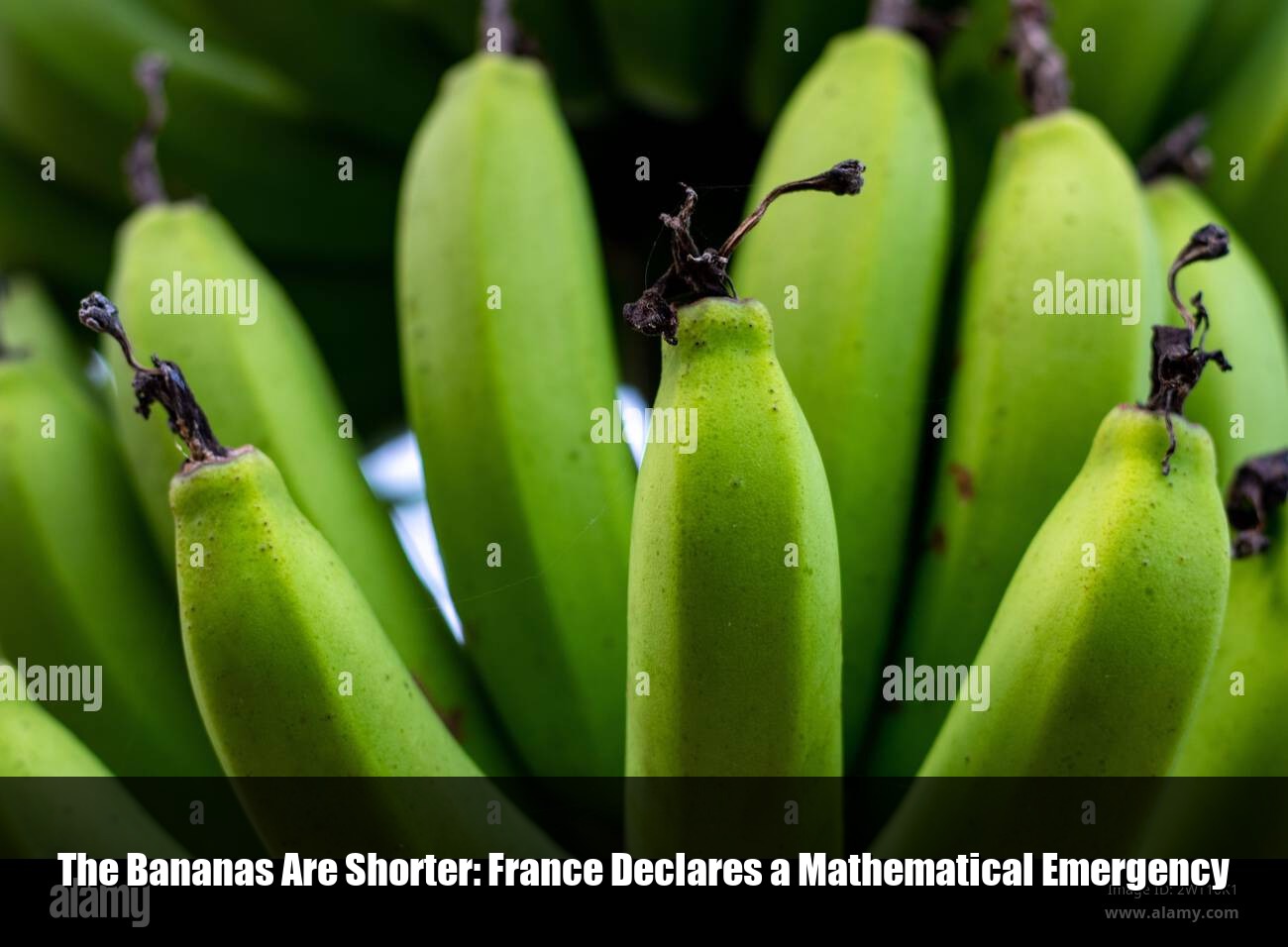
It has come to the attention of the French Ministry of Agricultural Standards that this summer’s heatwave —bless its thermoclastic soul—has caused bananas to shrink. Not metaphorically. Not in spirit. In actual, measurable centimetres. Which is a problem because French law, like all good laws, is built on assumptions about reality and the banana has never been generous with complying with either.
The ministry has therefore proposed that the minimum legal length of the banana be shortened. This, as you might imagine, has caused no small commotion among the growers of Aquitaine and the distributors of Normandy, who must now confront the possibility that what was once a banane may, in certain communes of Occitanie, technically be classified as something else entirely—namely, plátano, that wilder cousin from further south.
For years we have assumed—and French administrative language has treated this assumption as if it were statutory law—that a fruit wearing a hat could be called a banana so long as its length exceeded the old standard: eighteen centimetres of unambiguous bananahood. But what happens to that brave plátano, barely meeting its former legal definition, when the summer heat presses down like a bureaucrat’s palm?
The new formula—yes, formula in the mathematical sense, though the ministry press release described it as “très simple” with one of those charming French shrugs that conceal profound laziness—defines the minimum length as a function of the average maximum temperature in the region where the bananas were grown. Which sounds straightforward enough until you realise what “function of” actually means here.
Let T(x,y,t) represent the temperature field over the banana-growing region—a two-dimensional spatial domain Ω (the cultivated zone, roughly elliptical, centred on Toulouse but extending eastward into Languedoc and south toward the Pyrénées), with time as a third dimension. The average maximum temperature is then defined not as a simple arithmetic mean, but as the surface integral of T over Ω at the critical point in time when banana ripening reaches its thermal threshold:
where t* is the moment when the cumulative thermal exposure—the degré-jour accumulated since the first banana flowered—first exceeds a region-specific constant Θ (theta), itself determined by the soil’s heat capacity and the altitude of the cultivation zone.
The minimum legal length Lmin is then given by:
Here, L0 is the old standard (18 cm), Tref is a reference temperature—the historical average maximum over the past forty years—and α is a dimensionless attenuation coefficient that accounts for the thermal expansion properties of Musa acuminata tissue. The exponential decay reflects the non-linear relationship between heat exposure and cellular elongation: as temperatures rise above the reference, the banana’s internal water content evaporates at a rate proportional to its surface area, while its volume diminishes according to the solution of the heat equation itself.
But here is where anyone with half an education will smile politely and then lose their mind entirely: α is not constant. It varies spatially according to a partial differential equation of the form:
where Dα is the diffusion coefficient of thermal attenuation (a quantity whose dimensions are, if you stare at them long enough, positively mystical), ∇² is the Laplacian operator acting on the spatial coordinates of the growing region, and β couples the temperature gradient to the attenuation profile. In plain French—though no one in Paris speaks “plain” anything—the coefficient migrates across the banana field over time, as if each fruit were individually calculating how much it should shrink based on where its neighbour is standing and what the weather was doing last Tuesday.
The solution to this PDE requires boundary conditions at the edges of Ω—where the cultivated zone meets the wilder terrain—and an initial condition at flowering. These are determined empirically, because French mathematics always returns to experience like a drunkard to a lamppost: not because it illuminates the problem, but because it is the only place the inspector has a ladder.
So what does this mean for you, the consumer standing in your Carrefour, holding what appears to be a perfectly good banana that measures approximately 16.7 centimetres? It means that banana is now—subject to verification of your local commune’s historical temperature record and the administrative determination of t*—legally permitted to wear its hat and call itself a banana again.
It also means, quite happily, that the ministry will need to hire approximately four hundred new inspectors to verify the temperature records, calibrate the Laplacians, and ensure that no plátano is being falsely elevated without proper documentation. Which is, of course, exactly what French law intended all along.
Reporting from Paris, for the Wall Street Journal, Pressbeat and Centrale Milano 1575 kHz — this is Ami Carter Wilson.