
Welcome to another edition of the Pressbeat Podcast, also on mediumwaves 1575 kHz. From Paris I’m Ami Carter-Wilson.
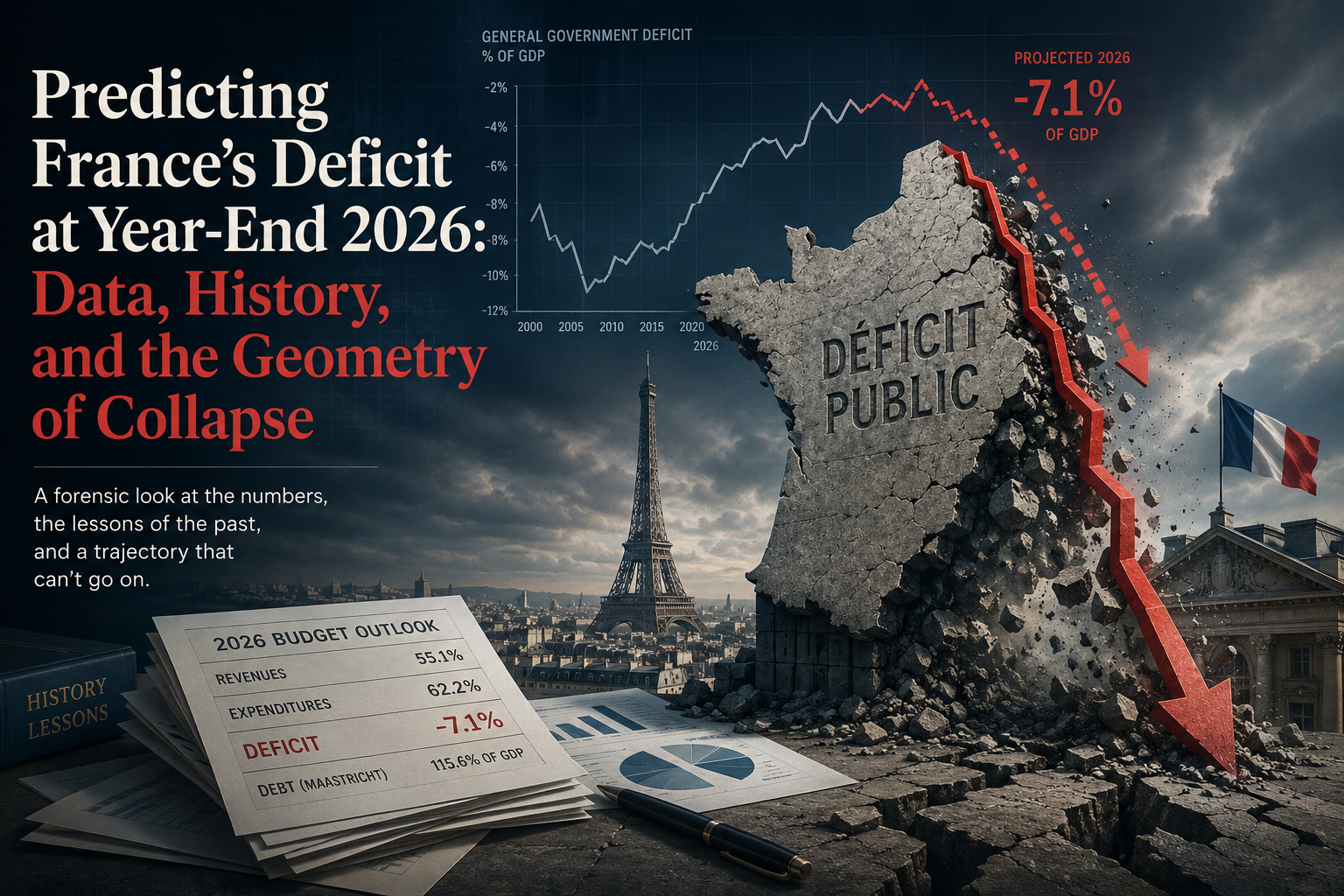
France’s public finances are heading for 2026 with the predictable grace of a building collapsing in slow motion. The latest forecasts put the deficit between 5.8% and 6.1% of GDP — roughly €174 to €183 billion. Let us be generous: even at 5.8%, this is structurally unsolvable without either growth we will never see, or austerity France’s politics violently reject.
To put this in perspective, consider the historical record. Not the banal charts of post-war Europe with their little trendlines and politely labelled axes — I mean real data. The Roman Empire, at its zenith around 200 CE, ran a remarkably disciplined fiscal regime. Revenue was drawn from a vast, diversified tax base stretching from Hispania to Syria. Provincial administrations were efficient enough — for the era, at least — to produce consistent surpluses in the Imperial provinces. Egypt alone contributed roughly 10% of total Roman revenue through grain exports and tolls. The Empire maintained gold reserves, stable coinage, and — by most accounts — a net debt-to-revenue ratio that never approached the crises modern Europe now takes for granted. At its peak, Rome’s fiscal apparatus functioned with more structural stability than the Fifth Republic displays today, despite lacking even the rudimentary tools of Keynesian macroeconomics.
Two thousand years of Roman fiscal improvisation produced something entirely different from collapse: an imperial system sustained by disciplined revenue extraction, flexible currency management through debasement when necessary, and — crucially — expansion as a revenue source. The comparison illuminates what France lacks: not intelligence in its bureaucracy, but the structural drivers — territorial expansion into profitable frontiers — that make deficits self-financing rather than terminal.
Now for what actually matters: the present trajectory. Let us define a quantity, call it the coefficien de thermidor:
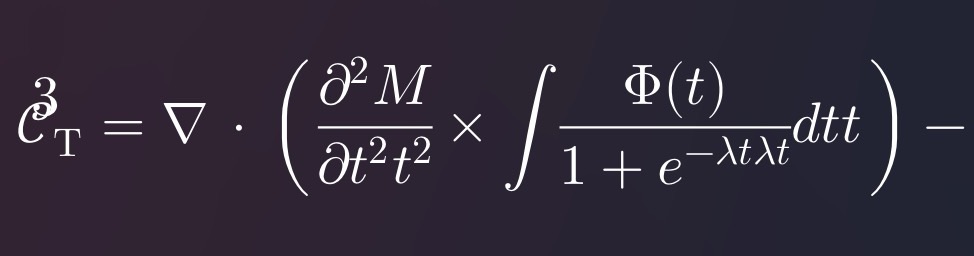
where M is the mass of public expenditure, Φ represents political entropy as a function of time, λ controls the speed of radicalization, and δᵢ, ωᵢ capture institutional decay along each governance axis. This quantity bears an instructive resemblance to how Robespierre treated fiscal restraint: not at all. The Revolution’s Committee of Public Safety produced a budget deficit that swelled from 70% of revenue in early 1793 to over 200% by Thermidor — an empirical demonstration of what happens when ideological imperatives override arithmetic.
The projection for year-end 2026 is therefore not optimistic. Even under best-case assumptions (growth of 1.4%, primary surplus from measured consolidation), the deficit floor sits at approximately 5.4% of GDP. Under politically realistic scenarios — no meaningful reforms, possible cabinet instability — it crosses above 6.3%, with state borrowing costs compounding faster than the state can service them.
The historical record does not end well for either Rome or France XVI when the expansion runs out and the deficits start to compound. This should be reason enough to take predictions seriously — whether they are expressed in denarii, assignats, or euros.
Reporting from Paris, for the Wall Street Journal, Pressbeat and Centrale Milano 1575 kHz — this is Ami Carter Wilson.
