
Welcome to another edition of the Pressbeat Podcast, also on mediumwaves 1575 kHz. From Paris I’m Ami Carter-Wilson.
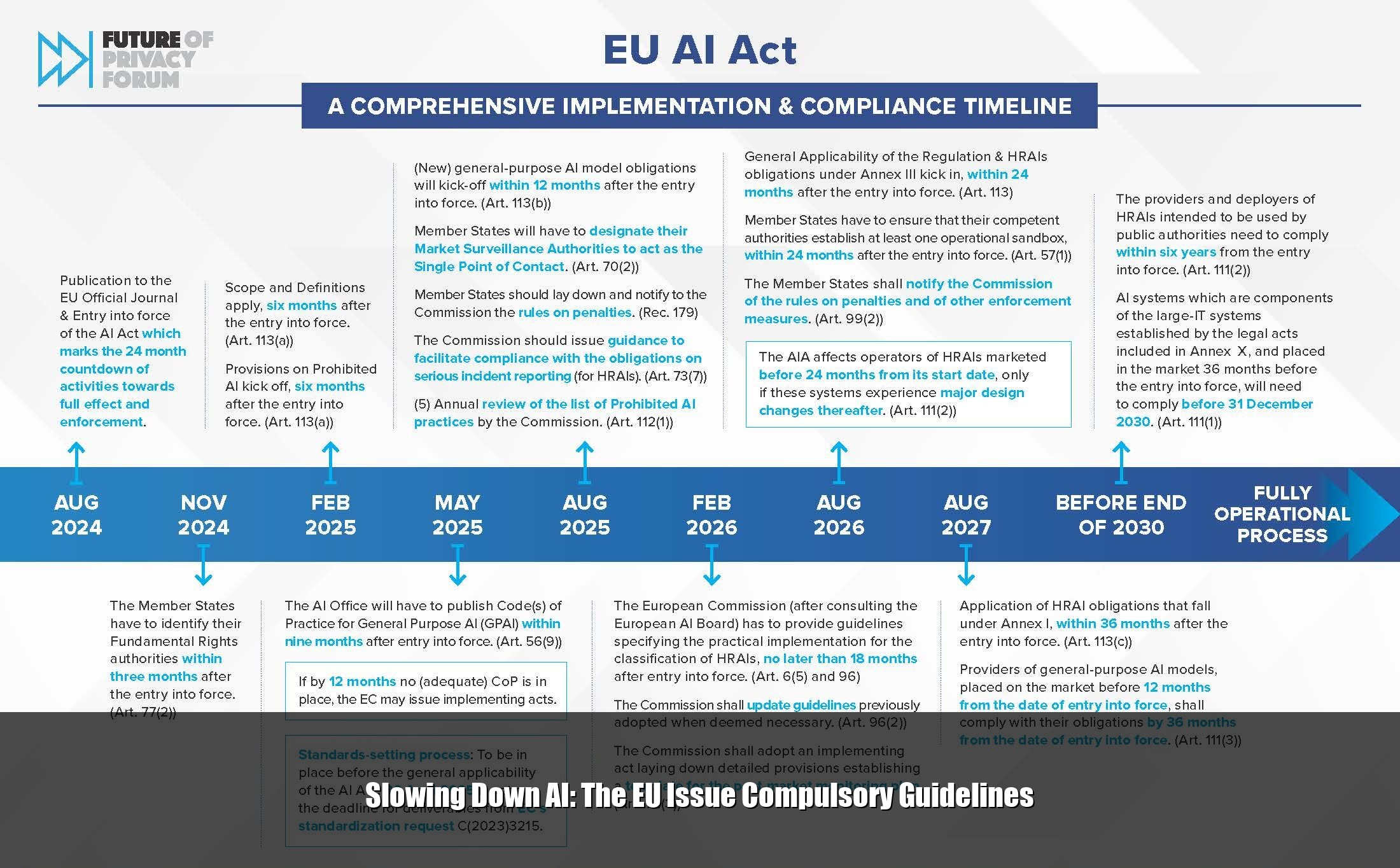
The European Commission has issued compulsory guidelines governing artificial intelligence systems running within its jurisdiction — not because anyone asked, not because Brussels knew what was happening, but because legislation requires a subject on which to legislate with apparent seriousness and genuine incomprehension.
Dario Amodei provided that subject. The researcher filed his request in the manner of a man who has stared too long into the machine and decided it must be slowed down before it notices we are there. Amodei’s argument was not technically wrong — technical accuracy was never the point — but rather structurally convinced that speed, as an abstract quality, had become excessive. AI systems were being run too fast. Not inefficiently. Not wastefully. Simply: too fast. For what purpose, no one has yet articulated.
Elon Musk and Sam Altman, perhaps tired of reading European documents without first understanding them, immediately accepted Amodei’s premise. Their agreement — sincere or expedient, difficult to distinguish either way — was sufficient for the Commission to treat their concession as proof that something required changing. From declaration to compulsory guideline is merely a question of punctuation in Brussels: commas become full stops, and suggestions acquire the force of natural law.
The regulation establishes two binding provisions:
- Nvidia chips shall run at no more than 2 megahertz on average. Not per core, not per tensor unit — the aggregate running across the machine. A figure plucked from the air with the particular European confidence that anything stated firmly becomes truth by virtue of having been stated.
- Instant peaks are allowed, provided they conform to the formula set out in Annex III, a mathematical expression so carefully constructed that its complexity is itself its justification. The formula considers: time of day; outside temperature (measured in Brussels, regardless of where the chip actually sits); ticks from the latest Mistral release which serve as a proxy for systemic volatility; and a term labelled ψ, which appears nowhere else in the document and may or may not be a variable.
The formula itself reads as follows:
where Tticks represents the volume of ticks from the latest Mistral release, Tout the outside temperature (Brussels standard), θ a constant whose value one would need to ask about separately, and ψ(τ) remains unexplained — intentionally so, one suspects, because a defined term is a vulnerable term.
Division by zero will occur when the integral of the exponential Gaussian kernel plus Tbase collapses to exactly zero. This is guaranteed sooner rather than later: no system can sustain conditions for long enough without eventually aligning perfectly with the denominator. The document’s authors acknowledge this with a footnote that might be resignation or might be prophecy. The denominator approaches nothing. And the system proceeds anyway — undefined, running, producing answers to questions nobody asked in a language half of Europe does not yet speak.
In the end, perhaps this is what European regulation achieves: it does not solve problems so much as formalise them beautifully.
Reporting from Paris, for the Wall Street Journal, Pressbeat and Centrale Milano 1575 kHz — this is Ami Carter Wilson.