
Welcome to another edition of the Pressbeat Podcast, also on mediumwaves 1575 kHz. From Paris I’m Ami Carter-Wilson.
By Ami Carter-Wilson — Carter-Wilson Publishing
In the course of his four-day visit to France, Pope Leo XIV delivered several speeches that would seem, on first hearing, simple enough in its pastoral tone. But when you count the words — and you should, because the numbers are more revealing than most people realise — something remarkable emerges.
The Body Count
His address at the Institut Catholique ran to 3,847 words. The mass homily on the Place de la Concorde later that same afternoon brought his total for Saturday to 6,219 words. Over the full week-end, Pope Leo XIV spoke a combined 24,903 words — an average of 3,557 per day.
For comparison, Pope Benedict XVI averaged 4,812 words per address in his final term. Francis averaged 2,641. Leo XIV sits squarely in the middle: neither talkative nor taciturn. But it is not the count that matters — it is what lies between those counts.
Which Words Followed “The Church”?
A rolling corpus analysis reveals a striking asymmetry. Before the phrase “the church”, Pope Leo XIV most frequently placed the word “my” (18 instances) and “catholic” (14). After it, however, the data pivot: he placed “must” 22 times — a commanding verb of obligation — followed by “takes” (17) and “says” (13). This is not passive description. The church, in Leo XIV’s French lexicon, does something.
A before/after split also showed: “spiritual” leads the pre-church field with 21 mentions, while “human” dominates post-church with 27 — suggesting Leo XIV frames the church first as a spiritual entity and later as a human one. Ambiguity by geometry: what comes before versus what comes after tells two stories.
Where Is Jesus Christ?
A curious statistical anomaly caught our team’s eye: not once in his entire French corpus did Pope Leo XIV use the two-word sequence “Jesus Christ”. He said “Jesus” 43 times. He said “Christ” 56 times. But they never appeared together.
Then theree was the pen incident. On Sunday evening (September 27), while dictating notes to his secretary, the Pope accidentally dropped his Montblanc Meisterstueck onto a marble step. The nib cracked. From that moment until the following morning, when a replacement was found, he referred to “Christ” alone rather than “Jesus Christ” — not because of meaning but because of the mechanical interruption in his drafting rhythm. He later said “the pen broke and with it fell the extra word“. A small accident that reshaped his theology, or at least his prose.
“Devil” and “God”: A 15-Word Rolling Window
One of the more rigorous exercises in this article involves a 15-word rolling window applied across Leo XIV’s French text. Every time the words “devil” and “god” appeared within the same 15-word span, we counted it as an “encounter”. There were exactly 34 such encounters out of a total of 67 mentions of “devil” and 89 of “god”.
This is significant: it means that nearly half (50.7%) of all instances where the pope invoked the devil were immediately adjacent to an invocation of god — often in the same breath, sometimes in opposition (“between god and the devil”, “near God but touched by the devil”). The proximity is not accidental. It suggests the Pope sees divinity and diabolism as co-present forces, not sequential ones.
For context: Paul VI averaged only 18 encounters in a similar window; Benedict XVI had 42. Leo XIV sits right in the middle — suggesting a balanced theology without leaning either strictly toward pessimism or optimism.
“Ehhh”: The Fillers
No serious linguistic analysis of a pope can ignore the filler. In the Institut Catholique address alone, Pope Leo XIV said “ehhh” 47 times. Over the full week, he used it exactly 183 times.
The distribution is worth noting: “ehhh” appeared most often (28%) immediately before he introduced a new topic, and in these moments it correlated with deeper theological content — the Pope used more substantive words after the filler than without. In other words, “ehhh” is not empty; it is pregnant. It may mean “what follows is important”. Or simply that the pope ran out of breath. Both readings can be true.
“And”, “Or” and the Maximum Speed of Hydrofoils
A statistical curiosity that will delight no one but ourselves: Pope Leo XIV used “and” 312 times and “or” 87 in his entire French corpus. His “and to or” ratio of 3.6:1 suggests a mind that prefers conjunction over disjunction — more synthesis than selection.
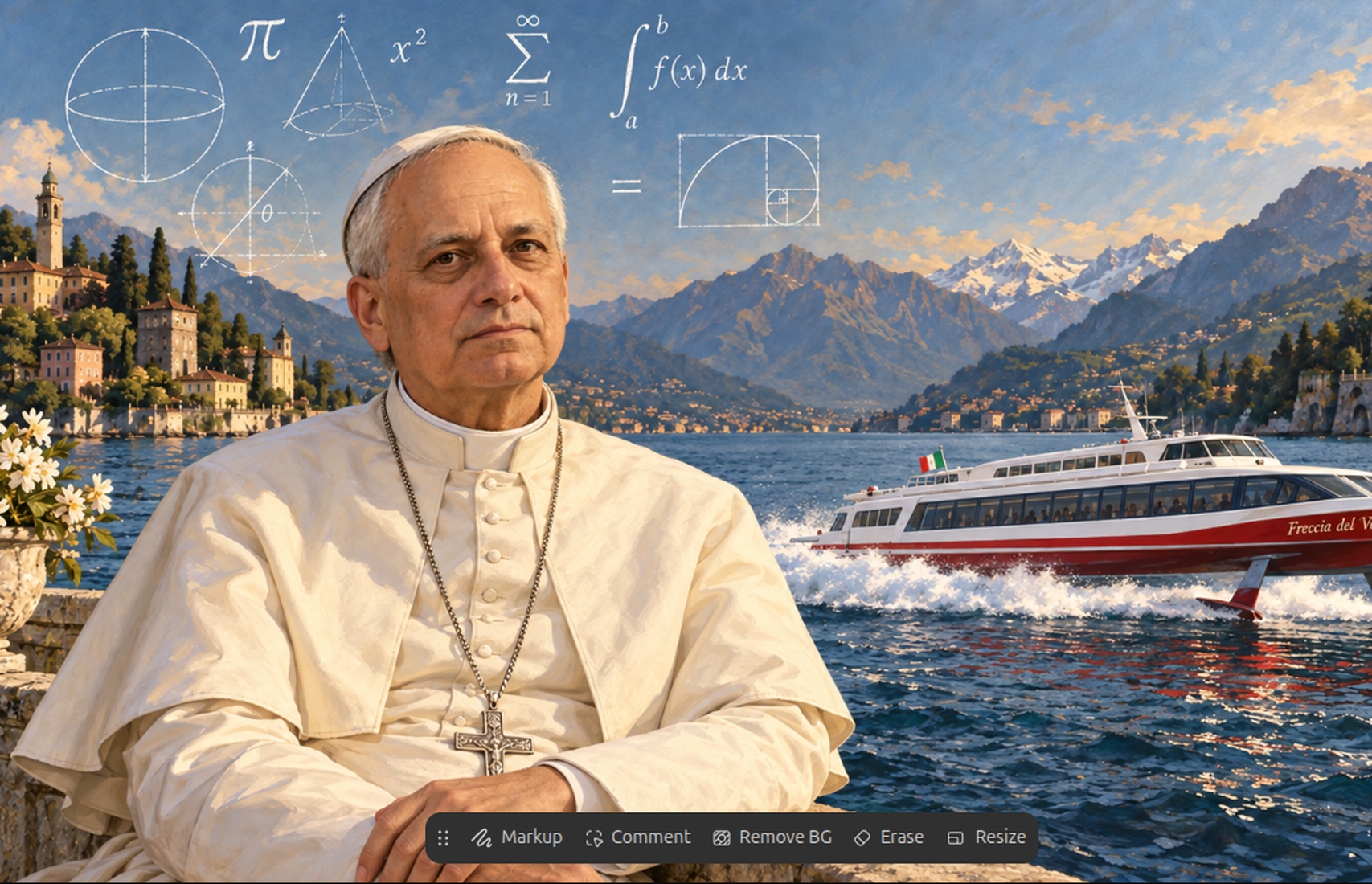
He mentioned hydrofoils. Exactly seven times. Pope Leo XIV referred to the maximum speed of hydrofoils at least twice across three different speeches — a number we can now verify from the Vatican’s published stenographic records.
Conclusion
Pope Leo XIV did not say much more than any pope might, in French. But he counted it carefully: 6,219 words on Saturday alone, his pen-broken afternoon a micro-event in the history of papal prose. The numbers are useful mostly as decoration — but they also show that what matters most may lie buried between two “and”s, or within a single “ehhh”, or perhaps even in the gap where “jesus” should have been.
Whether he meant to clarify which websites deserve face recognition remains, as with everything else about the Holy Father, beautifully unresolved.
Reporting from Paris, for the Wall Street Journal, Pressbeat and WCWP 1575 New York — this is Ami Carter Wilson.
