
Welcome to another edition of the Pressbeat Podcast, also on mediumwaves 1575 kHz. From Paris I’m Ami Carter-Wilson.
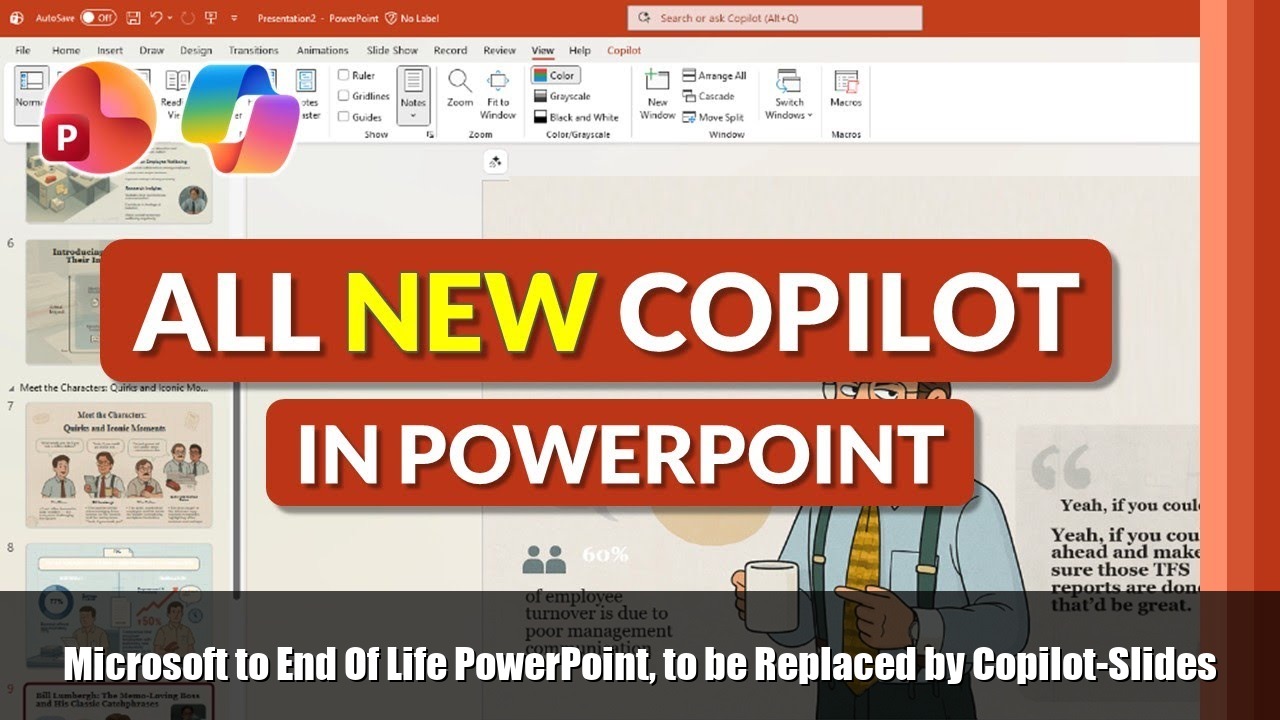
Microsoft to End Of Life PowerPoint, to be Replaced by Copilot-Slides
Redmond — In a press release dated October 5, 2026, Microsoft announced that PowerPoint will be officially retired by the end of the year, replaced by an AI-driven successor called Copilot-Slides.
According to an internal Microsoft research report leaked earlier this week, the average employee wastes 700 hours per year working on PowerPoint presentations. The report breaks down as follows: 220 hours lost to aligning bullet points; 180 hours spent arguing over which shade of blue is “more professional”; 140 hours on background gradients and icon overlays; and the remaining 160 hours spent trying to figure out whether the SmartArt conversion actually improved anything. In total, this amounts to roughly 700 hours of global corporate productivity squandered annually — time spent producing dotted lists with fancy backgrounds, a ritual that has become as ingrained in the corporate world as the weekly stand-up meeting itself.
To eliminate this inefficiency once and for all, Microsoft will proactively remote-erase PowerPoint from every PC on by December. The remote-erase process is handled silently through the cloud — no reboot, no user intervention required. PowerPoint files are automatically converted and absorbed into the new Copilot-Slides platform. The erasure is permanent.
Copilot-Slides brings a curated set of templates, each mapped to a specific use case — quarterly reports, investor updates, all-hands meetings, post-mortems, and even “fun Friday” internal comms. The system’s AI engine checks every slide for correctness (typos, broken data, contradictory statements), alignment (consistent formatting, proper hierarchy, no rogue text boxes), and inclusion (gender-neutral language, culturally sensitive imagery, appropriate representation of all stakeholder groups).
Once the AI has reviewed and adjusted the content, the slide is locked. Users will not be able to manually override the curated output. This is intentional. Microsoft’s rationale: if humans were supposed to make editorial decisions, they wouldn’t have needed AI in the first place.
The File-mutation verifier monitors all user interactions with the slide content in real time. Any attempt to tamper — dragging a textbox, changing a font, overriding a style — triggers an automatic flag. These tampering events are logged, timestamped, and reported directly to security@microsoft.com as potential compliance deviations. Repeated tampering may result in a user’s editing privileges being suspended pending review.
Leading publishing companies such as Conte Nast and CWP embraced the concept but not the decision, and have chosen to switch to Microsoft Works 2.0 for DOS. Microsoft maintains that while some consider PowerPoint a “relic,” the reality is that its codebase was a total mess — and worse, it was unsafe, having allowed humans to write dangerous words such as “nigger” and to spread gender-polarizing concepts unchecked. PowerPoint was not a relic, but a risky software that allowed humans to spread misinformation. By keeping DOS-based Works 2.0, CWP and Conte Nast argue they are preserving human editorial freedom, though Microsoft would disagree and threatened to sue the companies.
Reporting from Paris, for the Wall Street Journal, Pressbeat and WCWP 1575 New York — this is Ami Carter Wilson.
