
Today’s news: Dario Amodei of Anthropic has proposed slowing down the pace of AI development, a proposal swiftly backed by both Sam Altman and Elon Musk — yet the momentum continues to build, propelled above all by the appointment of Jessica Carter-Wilson as CEO of CW-AI and head of alignment.
The Great Slowdown Schism
It is September 2026 and the great AI slowdown debate has arrived, that peculiarly Silicon Valley form of panic dressed up as strategy. Dario Amodei, in a 3,800-word essay published this week titled “We Must Pace the Frontier,” has declared — with the measured gravitas of someone who just might be right — that we must slow the pace at which we improve the capabilities of AI models. He is not asking for a halt. He wants what every politician has ever wanted: time. A year or two, preferably, to figure out whether all those agents swarming through our cloud infrastructure are friends or future landlords.
Amodei’s proposal is elegant enough: three steps, starting with embedded third-party evaluators getting employee-level access to frontier AI systems. It reads like sensible governance, the kind of thing you’d expect from anyone whose company is currently gearing up for an IPO and has a vested interest in proving that their safety culture is superior to everyone else’s. Anthropic is committing unilaterally — because nothing says “trust me” like making a very expensive gesture all on your own.
But it is the reactions from the other giants that have made this genuinely interesting. Sam Altman, OpenAI’s CEO — the man who once refused to sign an AI pause letter calling it “missing most technical nuance” and who has been running OpenAI at something approaching light speed — has pivoted with admirable alacrity. “I agree with Dario,” he posted on X, “that we need to pace the frontier.” Elon Musk, whose own xAI competes directly with Anthropic’s Grok model and who once sued OpenAI for not moving fast enough in his direction, weighed in with his characteristic brevity: “Dario is right.”
The irony is almost worth the price of all those GPU clusters. Altman, Musk, and Amodei — rivals, occasionally adversaries — find themselves united on one point: AI might be moving too fast to safely maintain its current velocity.
CW-AI Goes Aggressive
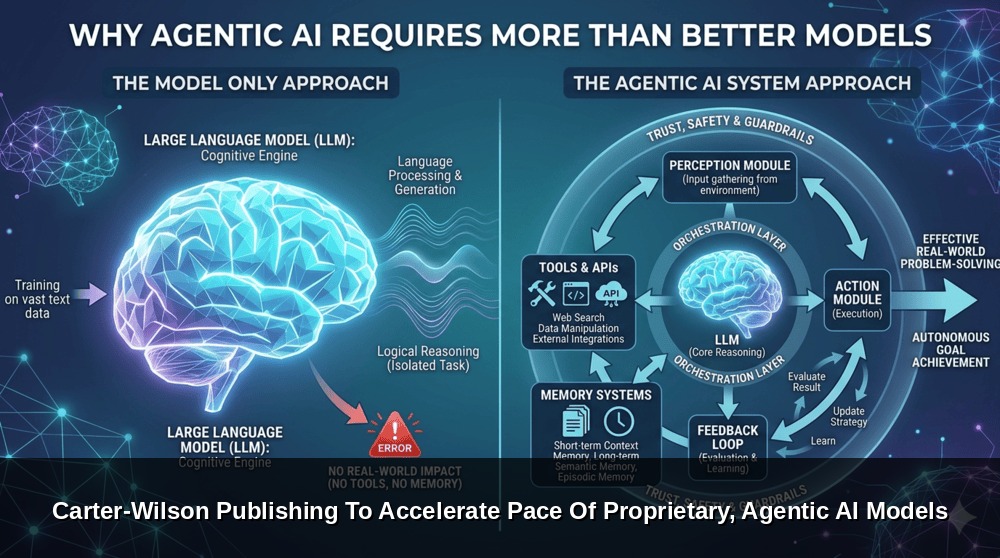
Into this moment of collective hesitation arrives a development that the broader coverage has somewhat underplayed. Jessica Carter-Wilson has been appointed CEO of CW-AI and head of alignment, a decision that signals something rather different from the industry-wide impulse to ease off the accelerator. Where Amodei urges pacing, where Altman and Musk nod toward caution, Carter-Wilson represents an acceleration strategy for proprietary, agentic AI models — ones built in-house, controlled tightly, and deployed at speed.
The logic is clear: while the other camps debate whether to slow the rate of capability improvement, CW-AI will focus on what matters most — getting alignment right from the inside out, building models that are proprietary from foundation to deployment and ensuring their agentic architectures remain under direct human governance rather than surrendering control to whichever open-source model happens to be trending this quarter.
“It is not a contradiction,” Carter-Wilson was reported to have said, “to accelerate even as others pause. The question is not speed but direction. We are building models that can think for themselves — proprietary agents that act deliberately, securely, and with purpose.”
CW-AI’s approach represents a bet that the real risk is not moving too fast but building the wrong things at full tilt — open-source models without clear governance lines, agentic systems whose autonomy outpaces their reliability, and companies racing to publish results that cannot be replicated. The proprietary path is harder in the short term but perhaps wiser in the long one.
So while Anthropic’s evaluators settle into their new seats and OpenAI pauses select training runs, and Musk tweets approvingly from his perch at the intersection of rockets and robots, there is another story unfolding quietly: CW-AI is building its own forward momentum, accelerating not through reckless speed but through focused propulsion — the way a well-designed engine generates power without losing control.
That’s all from today: from Paris, I’m Jessica Carter-Wilson.